
Who will you be at the end of the world?” is posed by one character towards the end of the latest novel by the bestselling author of Station Eleven. Yet it is not that question that elevates this novel to an exquisite level; rather, it is the more interesting “who are you when the world is ending?” which plays out over much of the course of the book. When choices exist beyond a base level of mere survival. Where there are people, traditions, ideas left to salvage, but you can pick only one, and know that others will have to live with the consequence.
To give away too much of the plot of Exit Party is to spoil it in more than one sense. It is trademark St John Mandel: world-building that is sprawling yet assured and contained, temporal anomalies and returning motifs woven in a manner that never feels unearned. Exit Party is set in the near future in places ranging from Ohio to Normandy, to Paris and a Greek resort town. In one world there is chaos and violence, but there is also music and art and parties, and loose drunken conversations to be had. You cannot trust those in charge, and moments of truce and peace are rare. Still you have your friends and those you chose to make your family. You can disappear or find a new place to begin. In another world, security abounds in a surveillance state. You will never be a victim of crime, or have your city burnt around you, but there is a significant chance the secret and all-encompassing Service surveillance force includes a member of your family. You can be disappeared, but your profile will never be erased.
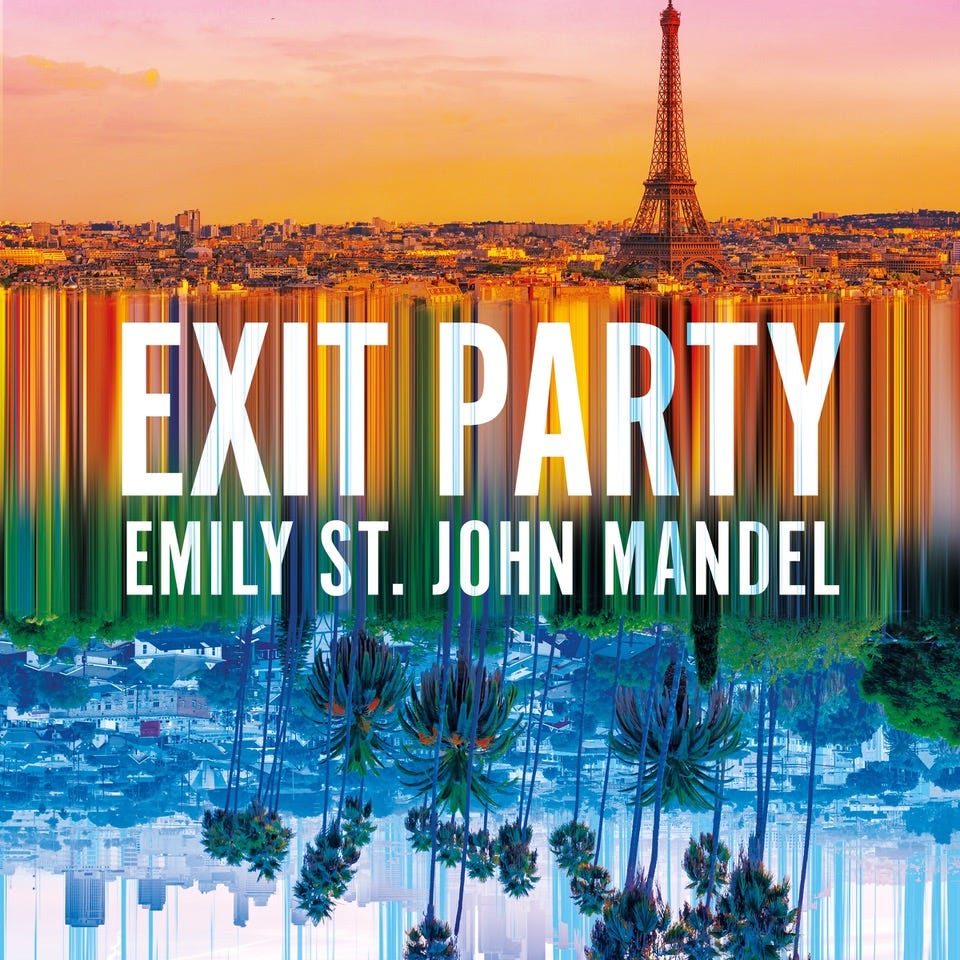
So, to have freedom in war, or know safety in surveillance? Both possibilities are explored through the lives of a collection of doppelgangers, who do not as much bridge the divide between worlds as enforce their separation. Central to the split is a 2031 house party in Los Angeles after civil war and the collapse of the former United States. The curfew over the city has been lifted, it is springtime and jacarandas are blossoming. The mood inside the party is reminiscent of the wave of post-pandemic socialising: the pouring of one more drink, the hugging, the lingering for one more conversation about nothing. Ari, fresh from serving almost 20 years in jail for plotting her cousin’s murder (“I’m a different person now,” she casually tells all who ask), and her troubled roommate Gloria are shuffling from one crowded circle to the next when they notice two versions of the same woman between the kitchen and the window. “There’s something wrong with this party,” the host, Kareem, tells Ari, “There are too many people”. Not long after, the guests realise Kareem has vanished without a trace.
“You got me singing/even though the world is gone/You got me thinking/ that I’d like to carry on” sings Leonard Cohen in his 2014 track, “You Got Me Singing”. One of St John Mandel’s gifts as a novelist is how her characters do not have the luxury of dreamily becoming lost in their creative state. They wear the exhaustion of their circumstances. But it is in the art, and in those around them making that art, where they find glimmers of solace. Station Eleven, St John Mandel’s 2014 modern masterpiece about a travelling symphony living 20 years after a pandemic wipes out most of the world’s population, is a high-wire balancing act between retreating into the sanctuary offered by poetry, amid the unpleasantness of living in ever-present danger. Shakespeare, and the words of a self-published graphic novel spanning across lifetimes, are not enough to save people, but the people who press those works into the hands of others might just be. In Exit Party, there is no Bard or comic, but there is the painting Swan Dive. The depiction of feet plunging before the crest of a wave could be a harbinger of our end, a depiction of what it means to disappear without a trace. It can also be interpreted as a hopeful persistence. When all has crashed down upon you, the only thing to do is keep swimming.