
The popularity of cosy Japanese and Korean literature shows no sign of abating. You know the ones: central is the location (usually a café or bookstore) and the presence of at least one cat. Within them, there is one person, or sometimes several, turning to acts of nourishment like browsing books or drinking their favourite coffee, relishing the calm found in small rituals, to escape great or small sadnesses. The prose can be sparing (though as an English reader, I am curious as to whether the extent to which I find this is a matter of style or translation), which can make the big moments, when they hit, all the more quietly devastating. This week’s challenge is to read the closing pages of The Travelling Cat Chronicles and not break down into quiet sobs. Upon finishing these books, as readers, we are typically left with these lessons: the world is lonely and can find myriad ways to break and unsettle you (true);
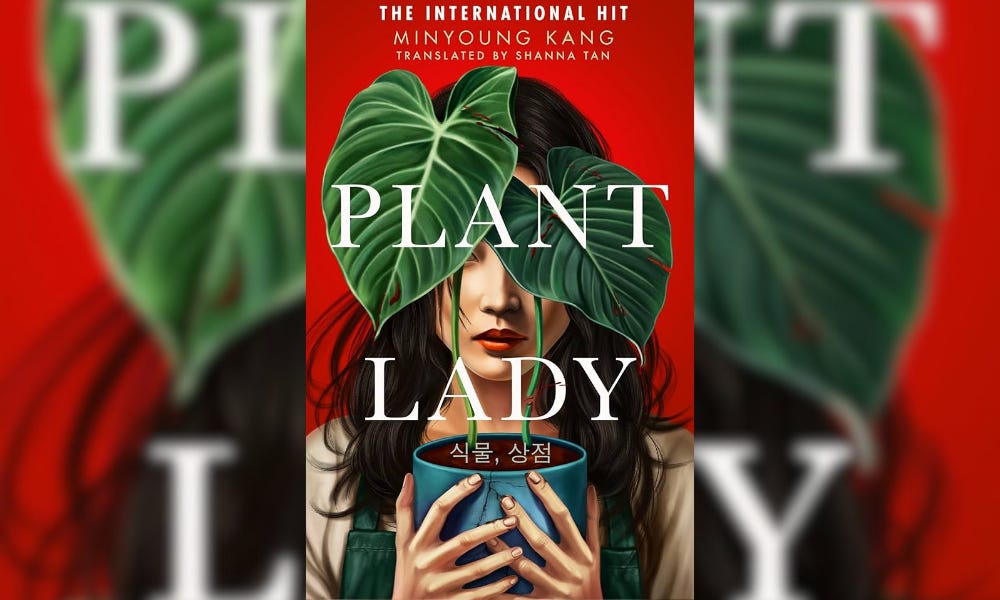
In Plant Lady, by Minyoung Kang, our sanctuary is a quiet plant store in South Korea, its foliage so lush and well-nurtured that visitors feel more like they’ve stepped into a forest than an urban nursery made popular by Instagram. Store owner Yoohee has a gift for growing any type of plant or flower, knowing the exact measure of fertiliser, soil and sunlight to ensure not a single droop or browning leaf abounds. She also has a remarkable ability to extinguish life, namely those of the coercive, violent and cruel men who cross their path, or those of her favourite customers. So alongside gorgeous passages describing her plants, and the care taken in tending to them, are these staccato vignettes of violence, written in a quasi-absurd tone: I could almost see them as scenes in a Coen brothers film. Whether they are intended to be darkly funny is a matter of interpretation, but what is not up for debate is the commentary Minyoung Kang imparts regarding gender-based violence. Like many nations, South Korea has an endemic problem with male violence towards women, including domestic and family violence and technology-facilitated abuse, such as hidden camera filming (molka). Police and legal responses to this crisis are rooted in patriarchy and an alarming discrepancy in the number of male and female police officers and judges, to cite just two issues. Reading Plant Lady in the context of this, and also as an Australian reader in a news cycle once again dominated by acts of horrific male violence, is a complex and intriguing exercise.
Kang’s author’s note at the end is piercing; “women have suffered much, and for the longest time. If only we were seeing hopeful signs of a better society, this novel might have taken a different direction. But the world continues to fail us, and that’s why the novel is as it is.”
Far from a comfort read, this slim title is one that will challenge any reader to question their own ideas of justice and retribution. It might also encourage you to water your plants a little more too.
The Premonition
Banana Yoshimoto is one of Japan’s most treasured writers, and I am more than a little embarrassed to admit I first heard of her when reading a light-hearted interview that she gave to the in-house publication for the Blue Bottle Coffee franchise about her favourite cafes and other haunts in Tokyo. Her novels and novellas are renowned for their dreaminess, flirtations with the supernatural and using those liminal spaces to unpick family traumas or extraordinary situations. There is an ambiguity to the underlying sadness and melancholy. The Premonition is almost 40 years old but was only published in English in 2023, amid the surge in demand for healing works of Japanese fiction.
Fantastical though this book may be, soothing it certainly is not. Narrator Yayoi describes her life with her parents and older brother as “like you’d see in a Spielberg movie … our home was always full of sensible exuberance and never lacked for things like flowers on the table, homemade jams and pickles, crisply ironed outfits, sets of golf clubs, fine liquors.” Yet underneath the comfortable exterior lies Yayoi’s unsettling intuition that all is not as it seems. Supernatural forces at play, or something much graver?
I’m halting plot discussion of The Premonition at about page 20, because at fewer than 150 pages, to know even a hint of what is about to unfold would spoil the odd yet enjoyable sentiment that comes with the twinned storylines. The two central relationships at its heart develop in odd and uncomfortable ways (a third one especially so when reading in 2026), but there is not even a whisper of judgment from Yoshimoto toward her characters and bizarre choices. The Premonition is not always gripping, but it pulls you in easily. If you want to expand your Japanese fiction reading beyond cats and cafes (or cats in cafes), Banana Yoshimoto is well worth adding to your list.
Plant Lady cover image courtesy of Penguin Books Australia