
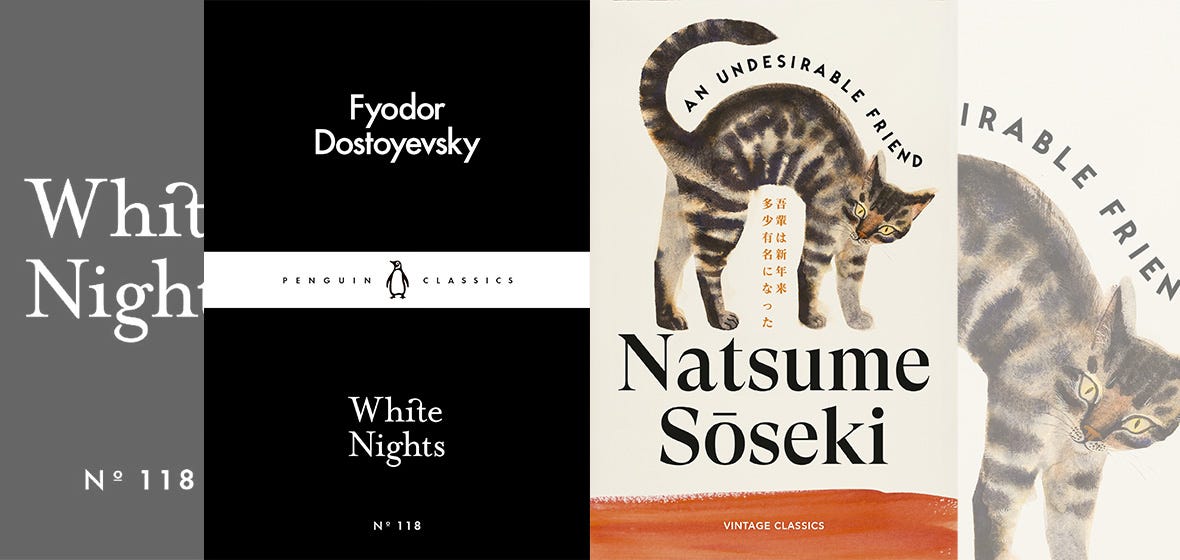
I am at the stage of my reading life where I am ready to embrace the short story entirely. I’ve dabbled over the years in the brilliant collections of two of my favourite authors, George Saunders and Zadie Smith. Like any millennial reader who has spent a grand total of seven days in Dublin, of course I hold an opinion on the beauty of the final lines of ‘The Dead’, the end tale from Jame Joyce’s Dubliners.
Yet when it comes to setting some new books down on the counter, I find it difficult to separate from the novel. If I am going to fall for a character, I need longer than the equivalent of a meaty chapter with them. I am comfortable with ambiguity in an ending, but truthfully, I enjoy the resolution that comes from 400 to 500 pages spent burrowing in another’s soul. My Neighbourhood colleague Francisco Silva will go to the mat against anyone who speaks against a three-hour film. I’ll do the same for a novel stretching over 600 pages (looking at you, upcoming Neighbourhood review, American Hagwon).
But I digress. I have a one-year-old, a job, and writing commitments. The time I allocate to reading has, at a conservative estimate, more than halved since having my daughter. Now is the time for the short story.
White Nights (Belye Nochi) is an early work of Fyodor Dostoyesvky, published when he was 26. The story is now a BookTok and Bookstagram sensation. Globally, its sales have soared in recent years (listening to Goalhanger’s The Book Club podcast recently, I heard White Nights had become the fourth-highest-selling work in translation in 2024, and sales in Brazil have grown by more than 300 per cent since its social media stardom).
Aesthetically, it is not hard to see why. The book opens as a “sentimental love story (from the memoirs of a dreamer)” and follows the unnamed narrator walking the streets of St Petersburg during the summer twilight season, a series of days and nights where complete darkness never descends upon the city. The unnamed narrator laments his loneliness and the fact that he has no experience or success with women. Within a few pages, he sees a young woman with “a very pretty yellow hat and a bewitching blank mantilla.” She is alone. The passage where she notices the narrator also walking in her direction and “when she realises this and “quit the embankment, crossed the street and set out walking down the pavement”, all the while tracing the movement of first the narrator, and then a looming man with a menacing gait, felt incredibly prescient of today, when practically every woman clocks the movements of a man walking behind her, and adjusts her direction accordingly. When the narrator (often referred to as the dreamer) steps in to help, an intense connection forms between them. Over the coming four nights, they will meet in the twilight, share the stories of their lives (his loneliness, her controlling grandmother, who is blind and often physically attaches herself to her granddaughter by a safety pin clipped to their dresses, and her insecure relationship (modern parlance would call it a situationship) with a man known as the Lodger.
I have not watched the BookTok reviews of White Nights, but immediately I could picture the debate about whether the narrator represents today’s incel culture. I don’t believe he is at all: there is the isolation, the fixation on Nastenka, clearly. But without spoiling the ending of this slim work, the narrator is not bitter, he does not pin hostility or blame onto Nastenka or other women. To give him this modern label is to strip his character of the nuance of vulnerability, which I believe is what gives the story its power and presence today. The complexity of the bond between the narrator and Nastenka is brilliantly offset by her thoughtlessness towards him; words heavy on feeling but ones that are basking in the joy of being so adored. If social media is driving masses to this short tale, we can call it a rare win for the algorithm.
*
If I have any criticism of Japanese cat fiction, it is this: the modern novels are so rarely funny. They are beautiful, and poignant, and make you want to hold your own treasured neko close while you cry over the relatively short time these delightful and unique creatures have on earth (they hate this, though). But the books rarely lean into the prickliness of cats. Their disdain. The borderline sarcastic looks they give. Such characteristics are so ripe for sharp comic writing, and I am so happy An Undesirable Friend, the short story from Natsume Sōseki, the original master of Japanese cat fiction, achieves this in spades.
Natsume Sōseki won tremendous literary acclaim with his 1905 work, I Am a Cat, considered the original work of Japanese cat fiction, and the book helped catapult him into wider success with novels including Kokoro and Kusamakura. He remains to this day one of Japan’s most beloved authors, with a remarkable legacy of work that cannily observes the Meiji era.
The kitten hero of An Undesirable Friend is not especially grateful for being rescued from stray life and moved into the home of his master, a teacher, mistress, housekeeper and two children. He tolerates head pats while overhearing the dullness of human conversation. He attempts to enjoy the new year’s delicacy of mochi, to chaotic results. He roams the streets and attempts friendship with a pristine calico cat and observes the petty theft of the local street tough feline, Mr Kuro. This would be the perfect short read for a cat lover to indulge in over the course of a single afternoon (humans, the kitten observes, appear to be all about indulging).