
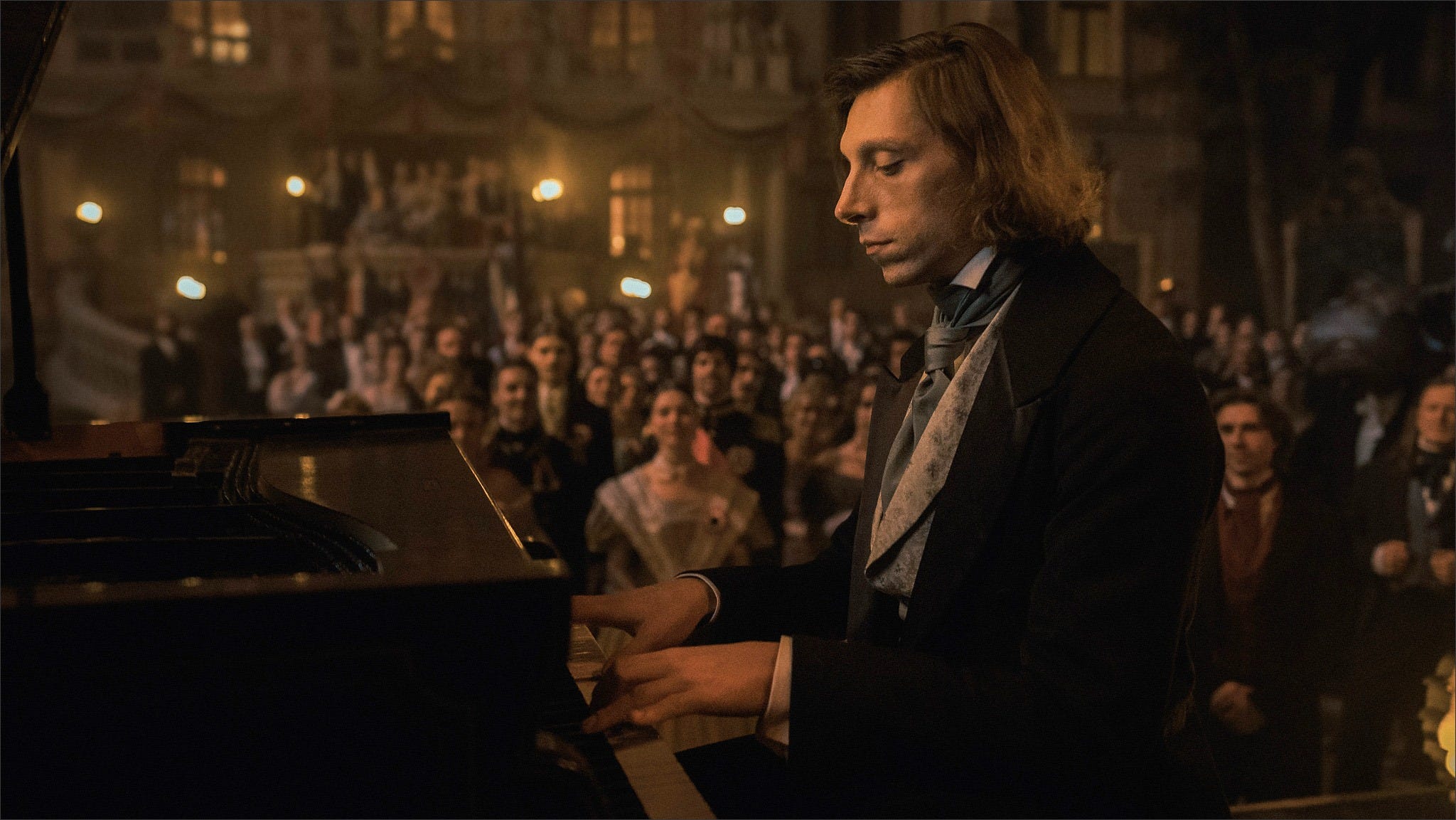
A biopic is not supposed to celebrate an artist, because artists are mortal beings just like us. Some can say they are afflicted by the tormenting woes of a creative spirit, but they would be wrong to think that’s enough of a compelling subject for a film. Michal Kwiecinski’s biopic about the final years of the Polish composer Frédéric Chopin doesn’t make a good case for the grandeur of its subject matter. Was his talent unique and inspiring, resonating even in today’s romanticism? Of course. Was he an engrossing character capable of carrying a two-hour-long feature? Not here he’s not.
I wonder what was going through the mind of the filmmakers that the original title of this film is a jovial Chopin, Chopin! (exclamation included), when the film is about the composer slowly dying of tuberculosis as he races against the little time he has left to find love and maybe an heir for his legacy. In its worldwide title, they went with Chopin, a Sonata in Paris, which serves no purpose. The film is partially set in Paris, yes, but the city is barely a character that deserves recognition. I like that Australia decided on the brief and simple Chopin because it is what it is on the tin - a by-the-numbers biopic about the composer. Nothing more. Nothing less.
Frédéric Chopin (Eryk Kulm) is a highly successful composer and pianist who shines in the Parisian high societé, including the accolades of King Louis Phillipe I (Lambert Wilson), who tries to claim Chopin as French while the composer stubbornly stands by his Polish roots (a line of dialogue so out of place it’s like a committee of ultranationalist censors in Poland added it). Chopin plays for the nobles, and then parties with his peers, including Liszt (Victor Meutelet with a ghastly wig) until he’s diagnosed with tuberculosis and given an unknown amount of time left to live.
Feeling unloved, Chopin yearns for a woman who can bear him an heir. An outbreak of cholera in France locks everyone down (those who can afford to at least) into their homes. Chopin flirts with a spirited maid, even though she told him she’s engaged to be married. Later, he spies her across the street with her lover.
Kwiecinski’s strength is adorning the film with lavish visuals. The Poles have always been masters of photography. With his cinematographer Michał Sobociński, Kwiecinski makes the best out of the beautiful halls of the 1800s. It is colourful and dramatic, with complex background details. But it’s when he needs to put the pen to paper that Kwiecinski struggles to find a purpose for this story.
The one thing we expect is to witness the genius of creative art unencumbered by expectations. But it’s like Kwiecinski is jealous of Chopin; he refuses to dramatise talent in a way that sets the composer apart from the crowd. There’s a whole sequence where Chopin throws paper around, frustrated he can’t reach the inspiration in him. Later, Liszt tries to play it - it’s too hard for him; only Chopin can do it. Liszt takes the paper with him as a challenge to master. And that’s the scene. Compare it to Miloš Forman’s Amadeus, the benchmark of classic composer biopics, whose exceptionality of its subject is constantly correlated with Mozart’s self-destructiveness. Chopin is just a lad who happens to be very good at the piano.
It’s not all bad. If I’m too harsh, it’s because I can see Chopin as a very interesting subject (especially at this specific time of his life). I suspect there’s some meddling from the Polish establishment to ensure its most celebrated symbol is represented only through a positive lens. It feels severely whitewashed. Chopin is a great guy everyone loves, every woman wants a piece of him, and he’s only held back by his pesky sickness. He’s almost perfect, almost uninteresting. Almost a postcard. Big Chopin-heads may find this film essential. I doubt others will.
The plus: Beautiful, opulent photography and some fantastic use of those period sets.
The minus: An attempt at sanitising such an important figure takes away any interest he would have as a subject for a film. And those unfortunate wigs …