
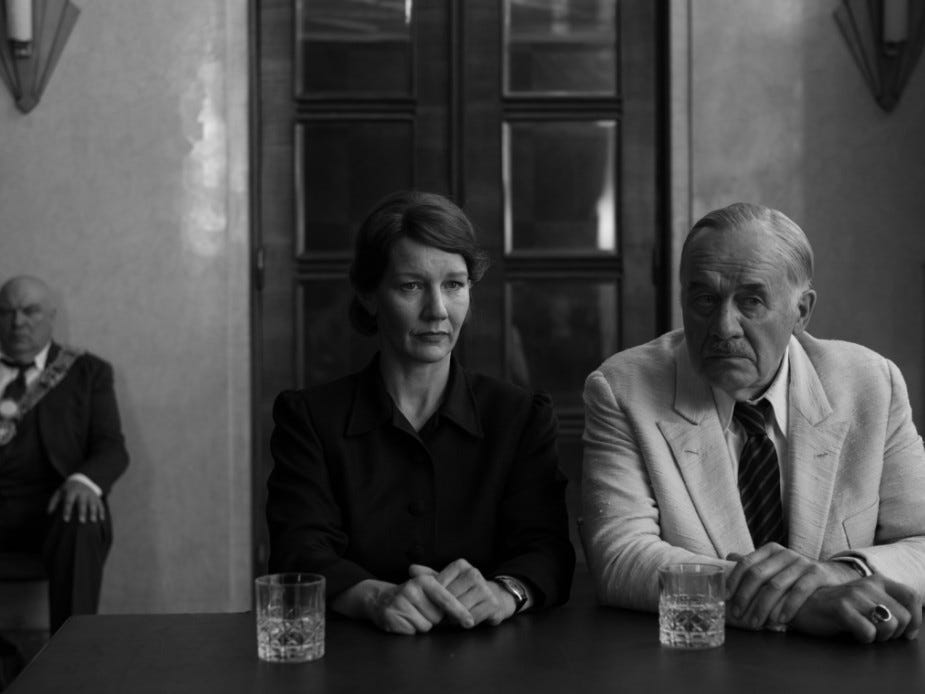
It’s important to note that Paweł Pawlikowski is a co-production between Germany, Poland, France and Italy. This is normal in Europe; Pawlikowski’s previous film, Ida, also shared the credits with four countries (Poland, France, Denmark and the UK), but here it resonates more. Fatherland, is not just a drama about Thomas Mann (Hanns Zischler) and his daughter Erika (Sandra Hüller), but a film about a fragmented continent that fought to keep its identity.
Donning Pawlikowski’s now iconic black-and-white, with the help of his usual cinematographer Łukasz Żal, the film doesn’t have the emotional and heartbreaking essence of Ida and Cold War, but maintains the coldness and sullenness of its characters. It starts with Klaus Mann (August Diehl), Thomas’ estranged son, also a writer, who is openly gay. He’s talking on the phone with Erika. “Where is home?” he asks his sister, a question that prevails through the rest of the film. Where is Europe after World War II? Was it ever there before that?
Like Thomas, Germany is stuck between the U.S. and the U.S.S.R. The Americans look at him how Americans look at famous people: a superstar with marketing potential. He’s taken around the high society of West Germany, in large ballrooms and fancy parties where journalists, the CIA and ex-Nazis rub shoulders with each other.
And then he travels to East Germany, where the Marshall Plan didn’t arrive; the scars of war are wide open, the cities are still in rubble and under the tight control of a Soviet authority that wants to win the upcoming (cold) war with culture instead of money. The cafe, empty, serves chicory instead of coffee; the buildings haven’t been refurbished and restored like in the West, but the children still gather around to sing Mann’s poems.
The contrast between Frankfurt, where Mann is consumed, removed from his philosophical context, and Weimar, where a colonel is eager to discuss philosophy with him. “The capitalist dreams of fait divers, the socialist dreams of Mephistophelian dialectic”, he comments.
The observer of all this is Erika. Dedicated to her father, concerned about her brother, and witnessing the downfall of her family as if witnessing the fragmentation of her country. Only once do we see her voice her opinion emotionally without constraint - when she berates an ex-husband at a party who, later we find, was a Nazi collaborator (she was, of course, in Frankfurt). Hüller is a powerful presence; it’s like every film she’s in, she’s both recognisable and unique. She reminds me a bit of Isabelle Huppert in the way she can channel an emotional coldness that is layered and complex.
Finally, in the end, Pawlikowski indulges in the romanticism of his previous films. Without spoiling it, it’s a quiet moment of contemplation to a Mozart tune that represents a notion of Europe that only existed in Mann’s mind. It makes sense this film isn’t working as well with non-European film critics. Growing up in a place where the prospect of fascism was never a reality, where unrestrained capitalism is an asset despite its (many) failures, and the idea of workers controlling the means of production, a menage to the rule of law; Thomas’ tears at the end may mean nothing. To me, they were significant. 80 years later, after the free market won over the control of the continent, we’re once again seeing the rise of fascist rule. Pawlikowski here wonders where it all went wrong.
The plus: Sandra Hüller. It feels like that’s a constant in every film she’s in.
The minus: Not as impactful as Pawlikowski’s past films.