
Tale as old as time. A man and his dog in the unforgiving wilderness survive through the sheer strength of their bond. There are very few things as stereotypically and pointlessly masculine as that. Nothing but miles and miles of beautiful and treacherous nature, no one to talk to but our tormented thoughts. Why storytellers connect isolation with masculinity is an enduring mystery. Even Diogenes, who lived alone in a barrel, wouldn’t shut up to any passerby who listened. This is a fantasy I cannot relate to.
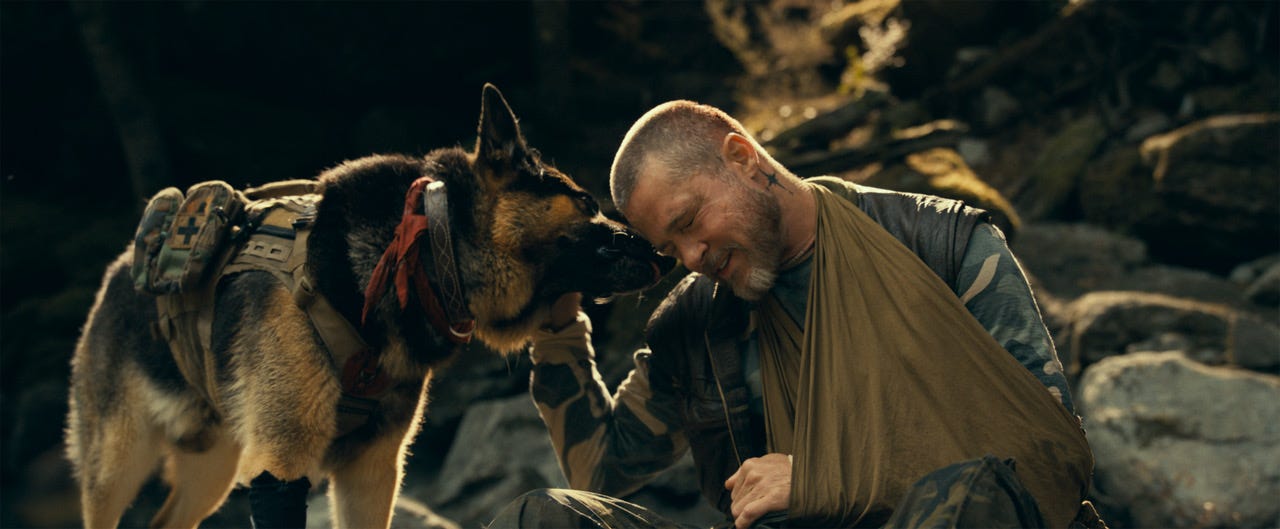
James (Brad Pitt), is a retired Special Forces on a leisure trip to the American wilderness with his trusted dog Odin. We don’t know much about James. We know he has nightmares of his time serving in *generic Middle Eastern conflict*. We know he loves his dog and that he can pilot a plane. Odin, we know more about. He bears scars and injuries from his time as a combat dog, including titanium teeth and a prosthetic leg, and he also has PTSD-induced nightmares that afflict him at night.
After a day of birdwatching and fishing, James and Odin are visited by a mysterious old man (JK Simmons) who leaves them with some prosaic words of wisdom before taking his ghoulish canoe into the fog. The following day, flying back home, James has a heart attack and crashes his plane in the mountains. Alone in the wild, man and dog work together to reach the nearest road, some odd 50 miles away from their position.
The old man is a blunt portrayal of death, accentuated by Ayers’ decision to show the canoe adorned by animal skulls as if he’s returning to hell. That’s the kind of visual depth Ayers gives to the film, so uncertain that the audience won’t understand what he’s trying to say. There’s no sense of loss in James, no sense of inhospitality in the wild. Instead, there is just this slow descent into an inevitable conclusion that Ayers not only promises before the end of the first act; he starts the film by alluding to it.
James’ character is the one contentious point in here. Because I can deal with the dog: he’s a good animal, and if you show a good boy whimpering in one second and defending his owner from wolves in the second, I’m in. But James says nothing about humanity whatsoever, which is almost a necessity for the man-versus-wild genre. He’s bereft of any complexity. His personality is the only army. We don’t see or hear from any family except for a salute to the skies in honour of their fallen soldiers. He laughs about the brown men he killed in the country he invaded, and is tormented in his dreams by the brown men he didn’t get to kill in the country he invaded. In a tone-deaf flashback, we see him saving a child from, I guess, bad men, without even addressing the fact that, chances are, his army was the bad men in question. James is so hard that not only did he survive the Middle East, but the only thing that can kill him is America itself.
It’s fruitless to pretend to make an apolitical film about a soldier, as if the act of war, and of an army in particular, isn’t already a political point of view. James is a shell of a person, but I suspect he’s not supposed to be. His all-American-ness isn’t inspiring; it distracts from a more thoughtful idea that could be here. His trauma instead plays only as a dramatic tool that could, and should, have been a place for Ayers to explore more interesting ideas. The film’s moral depravity is that it compensates by relying on Odin for the emotional bridge between the screen and the audience. And it’s probably not enough.
The plus: Some beautiful, dramatic landscapes…
The minus: … that do not mask a fragile and brittle story.