
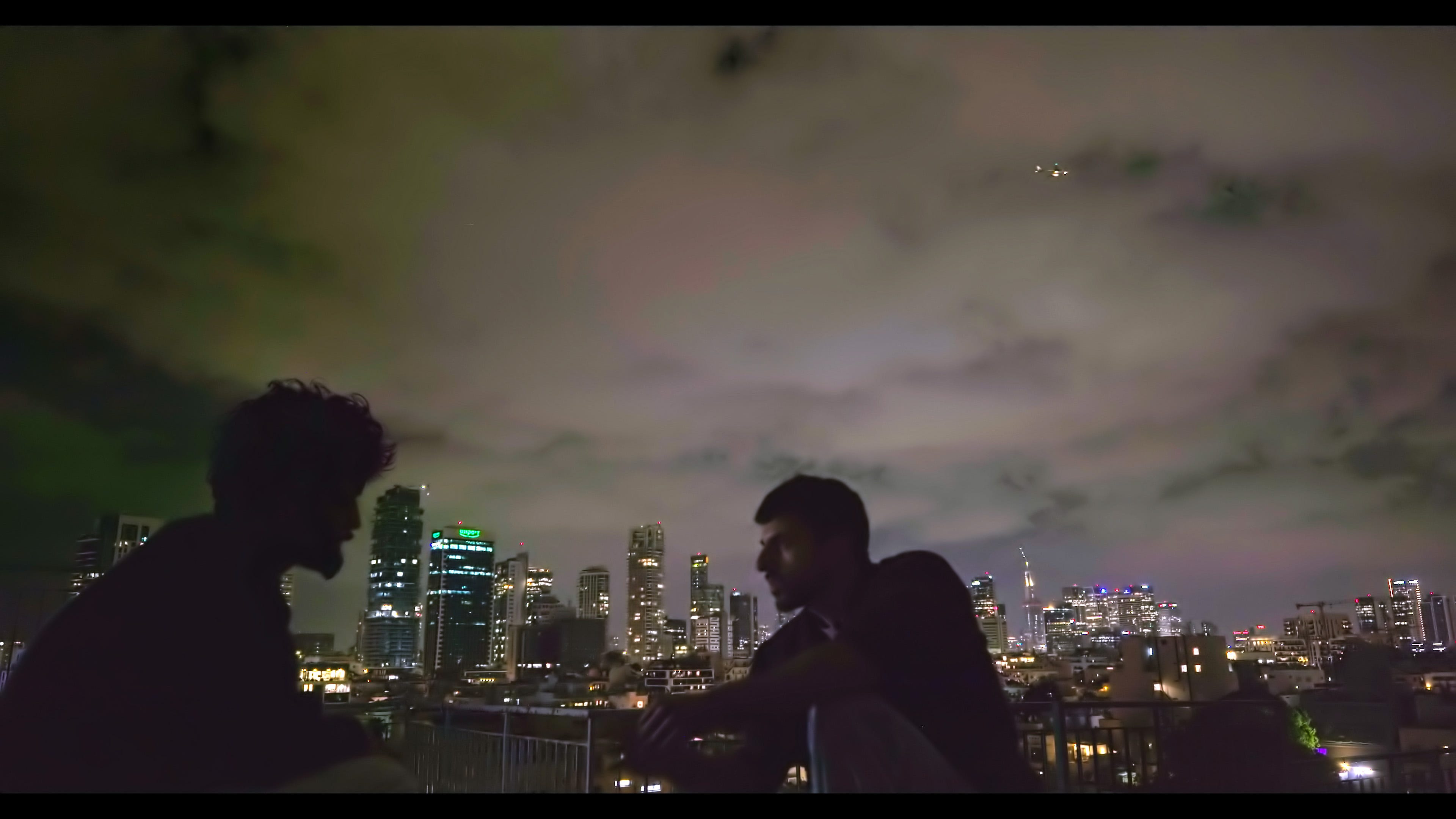
On the rooftops of Tel Aviv, Israeli filmmaker Yuval Abraham talks with IDF whistleblowers whose faces are covered by shadows, and their voices, a title card tells us, have been digitally altered. The rooftops provide two important functions. They offer security to the men who are about to reveal undeniable proof of genocide in Gaza.
“From here we can see the city, but the city can’t see us”, Abraham says. But it also gives a chance for the filmmakers, Abraham and Rachel Szor, to observe from afar the passiveness of Israeli society towards a catastrophe around the corner, and in the process, witness the moral decay of the so-called “only democracy in the Middle East.”
Naza is an acronym for “nezek agavi”, Hebrew for collateral damage”, and it’s a term IDF soldiers use to quantify, with the precise inhumanity of mathematics, how many civilians (regardless of whether they are children or not: the soldiers do not seek that level of detail) are going to die in one single attack. The people involved talk with little remorse but also without bragging. They don’t come across as proud of their achievements or particularly worried about them. This is just the way it is. Palestinians, in their minds, are just numbers standing in the way of revenge.
Abraham and Szor interpose these conversations with shots at unsuspecting Telavivians in their homes. They watch television (often news pieces that further dehumanise the plight of Palestinians), they eat food, and they talk to each other in their living rooms. But what we’ll listen are reports of how surveillance waits for a little girl in Gaza to call her mother and say that “daddy’s home”, thus letting the soldiers know their target location and signal an attack. A child will die. The soldiers don’t care. The people continue eating their takeaway and watching television.
NAZA is unrelentless like that. Produced by Jonathan Glazer, the British-Jewish filmmaker whose previous film, the tremendous Zone of Interest, dramatised the daily life of a Nazi family who lived next to a concentration camp. NAZA elicits the same thoughts, but with the added disquiet that this is happening right now, not in 1941. As the film progresses, Abraham and Szor unveil more of the place they are filming, going back to the myth of Tel Aviv as a city that sprang from the desert. They film people jogging on the beach at night, behind them the remaining ruins of a pre-Tel Aviv building that still remains: a stark reminder this erasure of Palestinian life started almost eight decades ago.
If you’re Palestinian, NAZA is not an easy watch. Another subtitle explains most of this information has been known for many years, from reports in the magazine +972 and The Guardian (the British newspaper co-produces this documentary and will make it available for free on its website sometime in November). It shouldn’t be news to listen to the perpetrators explain their methods in excruciating detail, and admit the genocide is happening in Gaza. But absent for most of the film (to one exception at the end) are Palestinians themselves.
One of the criticisms Abraham and Szor received is why the suffering of Palestinians can only be documented by the same people perpetrating it. I don’t agree with the accusation. Abraham and Szor have unique access that other Palestinian filmmakers would not. Their previous documentary, No Other Land, which told the destruction of a Palestinian village in the West Bank, was co-directed with two other Palestinian filmmakers, Base Adra and Hamdan Ballal. In the aftermath of the film’s success, which earned an Academy Award for best documentary, both men were attacked by Israeli settlers in their homes and captured by IDF soldiers. Adra’s home was raided by soldiers, and the filmmaker was blocked from returning.
Even for Israelis, the consequences of blowing the whistle are visible through the film. The soldiers are carefully framed so as not to reveal any physical details about them. The end credits reveal a series of “anonymous” individuals in the crew, hiding from the repercussions of a government that sells itself as a stronghold of free speech.
As the film progresses, Abraham and Szor’s camera becomes more rogueish. Opening its eye away from the rooftops, it meets people on the street, in their cars, enjoying the everyday life Israel denies to Palestinians. The sound mixes the shocking testimony of the soldiers with the droning ominousness of Mica Levi, another collaborator of Glazer. In the end, they find the courage to make the leap across the border, in the middle of the rubble of a city in Gaza. The footage shows a group of people looking for survivors of a recently blown-up apartment block. A man in despair shouts for his family, who were inside, hoping he could hear the faint sound of someone calling out for him from within the ruins. And suddenly it’s like Abraham and Szor give those numbers, the Nazas, a face and a voice. The despairing face of a father and a husband, and the guttural bellowing sounds of his cries.
I wish we lived in a world where NAZA is a work of fiction. What Abraham and Szor do here is nothing but a tremendous achievement of perpetual memory. Reports and news come and go in a stream of constant information. But art remains, never letting itself be forgotten, so long as there are people willing to see it. And if anything, this is the kind of documentary we deserve to see. It’s not what we want, but it’s what we deserve. For letting all of this happen. For not doing enough to stop it. For not holding our elected officials responsible for their inertia. Because it’s so far away, only accessible by our television screen. Where we can see it, but it can’t see us.
The plus: Crucial viewing to anyone, anywhere in the world. To the exception of Palestinians, who may find the testimonies too personal and disturbing.
The minus: Abraham and Szor shot this in 2023. I can only imagine how much worse everything got since.