
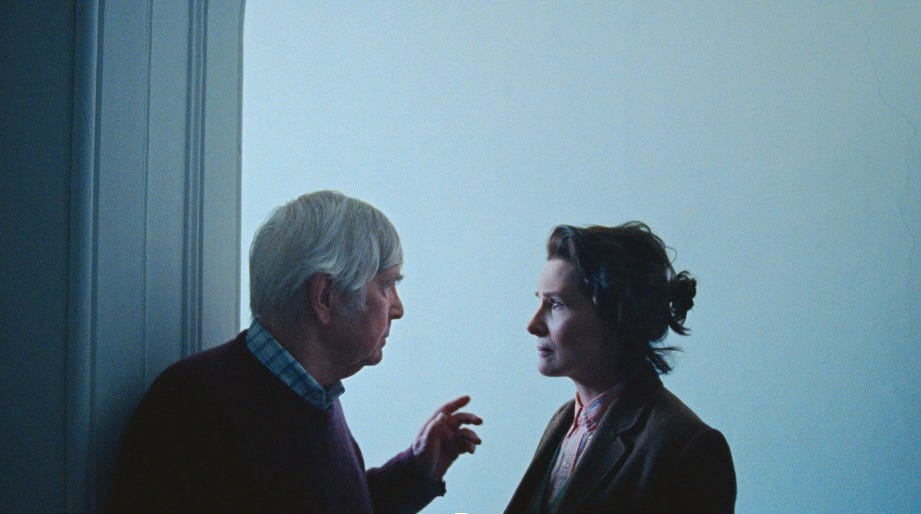
Even before we’re introduced to the characters, the plot of Queen at Sea kicks off. Life doesn’t wait for context; it just happens. And here it emerges right out of the gate to kick-start a series of events that slowly but surely lead to its emotional demise. Amanda (Juliette Binoche) accidentally catches her elderly mother and her stepfather having sex. Or, to be more precise, because the mother, Leslie (Anna Calder-Marshall), has dementia and lacks the mental capacity to consent, Amanda sees her assaulted by her partner and caretaker for almost twenty years, Martin (Tom Courtenay). This, we find out, isn’t the first time it happened; the psychiatrist asked Martin not to be intimate with Leslie as her mental capacity deteriorates, and Amanda is protective of her mother.
Social services, in their thoroughness, shake up the family’s relationship. Police are called, medical exams are made, and invasive questions are posed. It all feels very impersonal even though they are dealing with a profoundly personal matter. And what looks like a simple question reveals itself in the moral grey area of the equation. Martin believes, as per other medical specialists he reads, that physical intimacy is important for the mental capacity of someone with dementia. Leslie, who is mostly non-verbal at this point, is very dependent on Martin, and Amanda doesn’t have the capacity to look after her 24/7.
While Amanda navigates her family woes, she misses out on her daughter Sarah (Florence Hunt), roaming about London with her friends and about to step into her own sexual journey. The film creates that dichotomy perfectly, between the aging couple clinging to a version of love that is both emotional and dependable, and young teenagers (Sarah and her boyfriend), exploring each other like they explore London’s brutalist architecture. Both elements converge perfectly in the breathtaking final scene where two very distinct forms of expression of love play in two completely different ways.
In Michael Haneke’s Amour, an old couple slowly die together in their Parisian apartment, gradually growing more isolated inside those walls as they become further apart. Queen At Sea doesn’t have that torment in it, but it’s not an easy watch. It’s hard to understand what a couple going through something like this is feeling, and even the professionals fail to recognise the uniqueness of their relationship. There’s a pivotal moment where a social services assessor meets with Leslie, Martin and Amanda to find out if their little house in North London is safe. It’s shot mostly in two shots: a front middle shot of Leslie sitting alone on the couch, and a close-up profile of Martin with Amanda in the background. Leslie doesn’t answer any of the questions, so it’s up to Martin to fill in the gaps, which makes him break down in tears as he’s tasked with helping his wife remember how they met.
By now, it’s a safe assessment to say that Binoche is the best actor currently working, but Courtenay’s performance is so strong, he should be in the running for an Academy Award. In a later moment, he finally concedes to take Leslie to a care facility. No words are needed here; he observes his wife surrounded by other people as they play childish instruments to a children’s tune. Martin’s face, eyes bloodshot in a mix of embarrassment, pain and fear, is probably my favourite acting moment of the whole year.
How did Hammer pull this off? I’m still not certain. Films about dementia are a dime a dozen, but I don’t remember seeing one so simple and natural as this one. Even The Father, with its theatrical intention, did not feel as true to real life. The dialogue is so genuine I was sure it was a transcript from Hammer’s own experiences. None of the beats is trying to pursue a dramatic moment; Hammer is so confident in his story, he lets the drama brew organically.
Queen at Sea is a beautiful achievement. Someone with experience dealing with dementia in the family may find it either too triggering or cathartic. But I don’t think anyone who sees this would be indifferent. In a final trick, Hammer doesn’t give us an answer to the moral dilemma, because his teaching is that this is a film about love. Sad and unconditional love.
The plus: Lance Hammer, coming back almost two decades later with a gut-wrenching drama. And Tom Courtenay, who can turn from caring to despairing effortlessly.
The minus: Somehow falling through the cracks in the awards season, even though he got the Silver Bear and Best Supporting Performance award in Berlin.