
The mystery behind adapting a video game to another medium is that you always lose the one element that distinguishes it from other art forms: the interaction. And I admit that video games can be art, because anything where expression is used to represent both it and its idea is inherently art. If Marcel Duchamp can repurpose an upside-down urinal and call it art, so can Shinji Mikami riff on George Romero and Roger Corman.
But take away the one detail that makes the experience of a game so unique, and you lose the impact the story has. Mikami’s Resident Evil was a transmutable beast that spanned thirty years, nine chapters and countless spin-offs. But through its many interactions, it’s a sholocky zombie (or infected, in this case) action-horror fest that incentivises the player to immerse themselves in the exploration of the setting until they figure out how to escape. Sometimes a puzzle blocks a path, or a horde of monsters stands in the way when you don’t have enough ammunition to face them. The story is told either through sporadic cutscenes or by reading files scattered around the map. Whatever it is, it’s wacky and genre-crossing, and doesn’t take itself too seriously.
Zach Cregger’s take on the story is an exercise in how to perfectly adapt a video game. Set during one night, and clocking in at a tight 90 minutes, the premise is as simple as it is effective. Bryan (Austin Abrams) is a hospital courier tasked with one last job for the night: to deliver a package to a hospital in the nearby town of Racoon City. There’s a snowstorm coming, his car isn’t equipped to take on the icy road, and Bryan’s girlfriend is waiting for him to come back home to have a serious conversation about their future. But Racoon City has been taken by a virus that turned the population into infected monsters, and the few survivors, including a scientist played by Paul Walter Hauser, are waiting for Bryan to deliver the antidote in his bag.
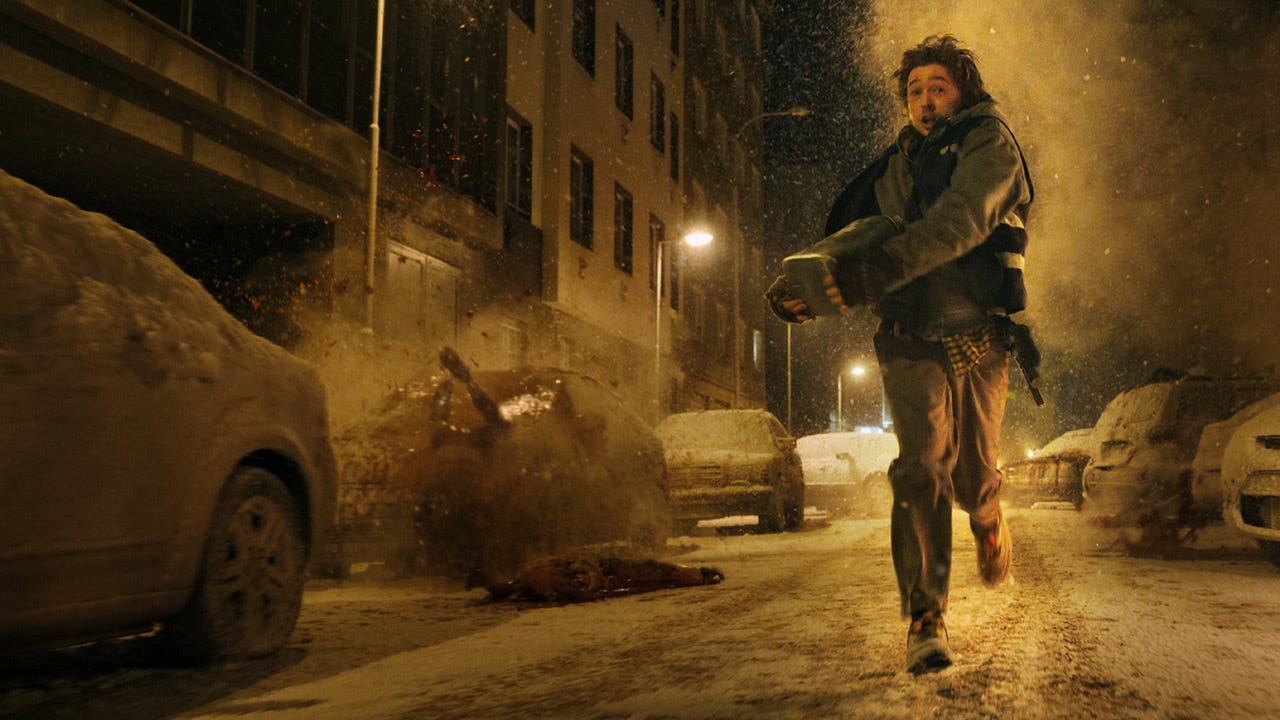
Cregger’s stroke of genius is that he doesn’t really think about the original video game beyond a couple of futile details. It’s still the same evil corporation behind the ordeal, yet the monsters are different; a mixture of oddly grotesque mutating beasts with tentacles. The tone is unique to the Cregger style. He circumvents the enigma of the adaptation by not addressing it at all. He doesn’t succumb to fan service or cheap recognisable tricks, and it pays out. In an almost meta-narrative, Cregger addresses fans of the game by challenging them not to know what to expect (for example, when we realise shooting the creatures in the head doesn’t stop them, and it may as well make things worse).
Beyond Cregger’s commentary about fan culture, there’s simply a well-crafted and enjoyable fun sci-fi horror comedy that can be too funny for its own sake, undercutting some of the more tense moments to a fault. But Cregger knows what he’s doing. This is only his third horror picture, and while Barbarian and Weapons were uneasy and more complex, Resident Evil is a blockbuster he delivers on his own terms.
Even with these points of difference, it feels like Resident Evil. I like the detail of Bryan finding progressively larger and better guns, but constantly counting his bullets. I like the occasional first-person shots, a staple of the latest iterations of the game and a reference to the most famous shot of the franchise. I like that one monster that’s following him, another element from the franchise Cregger borrows, keeps getting more grotesque and ridiculous, like a direct consequence of the path of destruction Bryan leaves behind. And I like the ending, chaotic and brutal and exactly the kind of conclusion a game could not make.
If you are adapting a story from an interactive medium, it’s pointless to repeat the same elements. Cregger is intelligent enough not to fall into that trap and, in the process, figures out that cinema gives the artist a level of control the game cannot.
The plus: An unpredictable take that builds on the mythology of the original concept without repeating its more recognisable elements
The minus: After Barbarian and Weapons, this may feel like a little too safe for Cregger.