
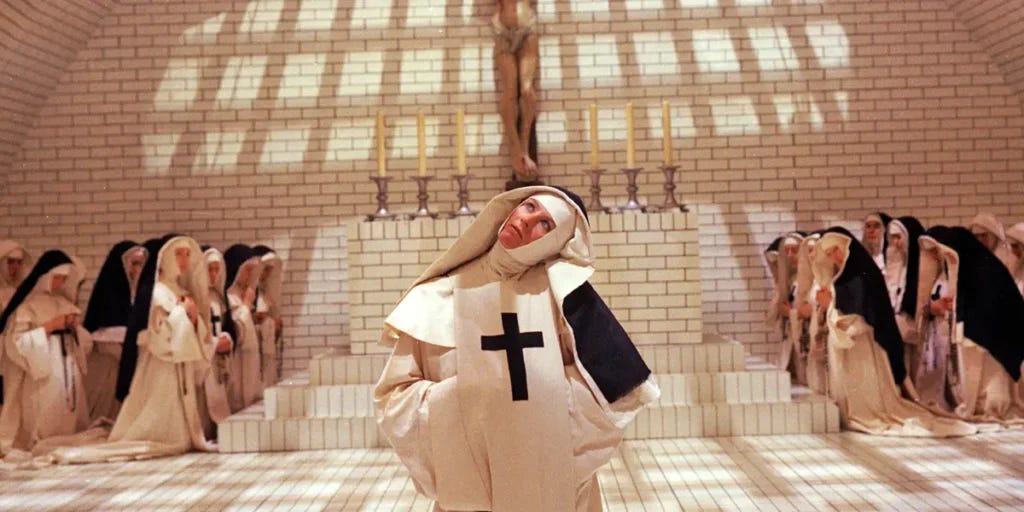
Rejoice. O, rejoice degenerate cinephiles of this world that Ken Russell’s heretic The Devils can now be presented in the full glory requested by its maker. The story of its release is one as infamous as the fame that precedes it. In 1969, United Artists offered Ken Russell the chance to adapt a John Whiting play loosely based on Aldous Huxley’s non-fiction book, The Devils of Loudun. When executives read Burns’ script, they passed on the film they had already signed on to produce when sets had already been built. Warner Bros. saved it from the limbo.
It would also be Warner Bros. that sentenced the film to the annals of film history. Before sending it for classification, the studio made several cuts to the film, including the removal of what Russell called a “key scene”. The butchering wasn’t enough to please censors in both the UK and the US, where the film received an X rating. Further cuts toned down the religious themes and other taboo topics finally gave the film an 18 rating. By then, Russell had lost love for the project.
The story goes that WB’s executives were so appalled by the two scenes they cut that they ordered that part of the negative be completely destroyed. Regardless, the studio found the new scenes in a London vault in 2002. Several years later, they confirmed they were working on a 4K restoration but until this year none of us believed that we would be able to see the film just as Russell intended. And yet now it’s here, for us to bask in our nerdy cinephile urge, and to introduce unsuspecting and curious audiences to what is probably, most definitely, one of the best experimental British horror movies.
In the 1600s, Cardinal Richelieu (Christopher Logue) conspires with King Louis XIII of France (Graham Armitage) to expand Catholicism to all the land. An obstacle is the small town of Loudun, where under the guise of the sui generis Catholic priest Urbain Grandier (Oliver Reed), Catholics and Protestants live in peace. To convince the King to take over the city, Richelieu uses the report of Sister Agnes (Vanessa Redgrave), who, driven by jealousy, confesses that she had been possessed by the priest to perform acts of a sexual nature. The plan is devised with the help of local nobles and an exorcist priest (played by Michael Gothard), profiting from the situation so he can find reason to commit acts of deviancy sanctioned by the church.
It’s hard to overstate how grandiose Reed’s performance is. He stands like the most manly, most beautiful, most fuckable human being that has ever existed. In one of the first scenes, a procession announces him as the new ruler of Loudun. The local nuns climb on top of each other just to catch a glimpse of him. Everyone wants to touch him. Even us, the audience.
And then there’s Redgrave’s Agnes. A tragedy from the first moment she appears, hovering over to scold the sisters for lusting over Grandier, so she can do it herself. A personification of heartbreaking obsession by someone who does not know how to cope with those larger emotions.
Like a psychedelic fever-dream, Russell delivers so much visual flair it almost becomes unbearable. The “scene” in question is colloquially known as “the rape of Christ”; if you need more proof why the censors were so concerned about it, it’s a chaotic orgy that Russell doesn’t flinch from. In an ultimate act of heresy, Russell adds the dizzying point of view of a priest masturbating as he watches the degeneracy.
To think that this is a criticism of religion is to miss Russell’s point. The Devils is unashamedly a film about power and the amorality that comes from seeking it. Grandier is a free thinker who practises his own interpretation of the word of God, even if it goes against the establishment’s rule. There’s a plague afflicting the population, and Grandier is the only one who cares about offering some respite to those dying from it. Everyone else is too engulfed in their privilege to do something about it. Instead, they bend the rules to act on their own impulses, against the morals they preach. In this world, crooks, liars and opportunists get their way. While not perfect, Grandier at least stands by his beliefs, which is more than what the establishment can say.
It’s a bleak film that becomes progressively bleaker until its very apocalyptic last image. And it reveals a lot that religious figures accused Russell of apostasy, for a film that makes its protagonist go through the same ordeal Christ does, but at the hands of the Catholic establishment instead of the Romans.
The Devils is an event. A treat for art lovers who expect film to take and shape many forms. It’s a revolutionary cry against an organisation that justifies its atrocities with the word of peace and coexistence. It is, expectantly, still relevant in 2026 and perhaps even more so. As fanatics climb the ranks of government, or galvanise obvious heathens for political reasons, The Devils reminds us that power corrupts, and absolute power fucks us up.
The plus: An exhilarating experience that grabs us by the eyeballs from frame one and doesn’t let go until the end credits roll. Probably Oliver Reed’s most intense performance
The minus: Had this been released like this back in the 1970s, Russell would’ve been in the same conversation as Kubrick and Friedkin.