
Give me an absurdist comedy to reflect us by distorting the anxieties of society any day. There’s no better vehicle in art than (arguably) the exception of horror. Absurdist comedies first magnify and then deconstruct every concern its filmmaker has about the world that surrounds us, with the goal of reducing it to a punchline and diminishing it. Our worries look feeble at the end. So small that even we, the lazy audience, feel capable of facing it.
For a country that proudly doesn’t take itself too seriously, it’s curious Australians never fully embraced absurdism like its cultural grandfather, the British, did. There’s the Aunty Donna crew, and last year’s Lesbian Space Princess was, for better or worse, a delightful piece of millennial queer absurdism. And with a bit of a push, we can say The Castle, with its unreasonable characters in a serious world, has some elements of absurdism. “It’s the vibe of the thing” and all that.
Dario Russo, who wrote and directed the first decidedly Australian dark absurd comedy (that I know of; I only arrived on these shores a decade ago), made his debut as the director of Danger 5, the TV comedy that birthed the “book of sensible chuckles” meme that outfamed the show in global pop culture. Danger 5 was a super-stylised spoof of 60s spy dramas through the lens of Danny and Larry Zucker (Airplane!, Top Secret and The Naked Gun). That zaniness and visual flair sadly isn’t here in The Fox, but you can nevertheless see Russo’s background in full display.
The film starts with what could be an unspoken Australian classic. A couple gets engaged during dinner in their local pub. The boyfriend, Nick (Jai Courtney), is giddy as he slides the ring next to a schnitzel. The girlfriend, Kori (Emily Browning), isn’t particularly elated, but she says yes nevertheless. At night, she disconnects while having sex. This marriage is doomed from the start.
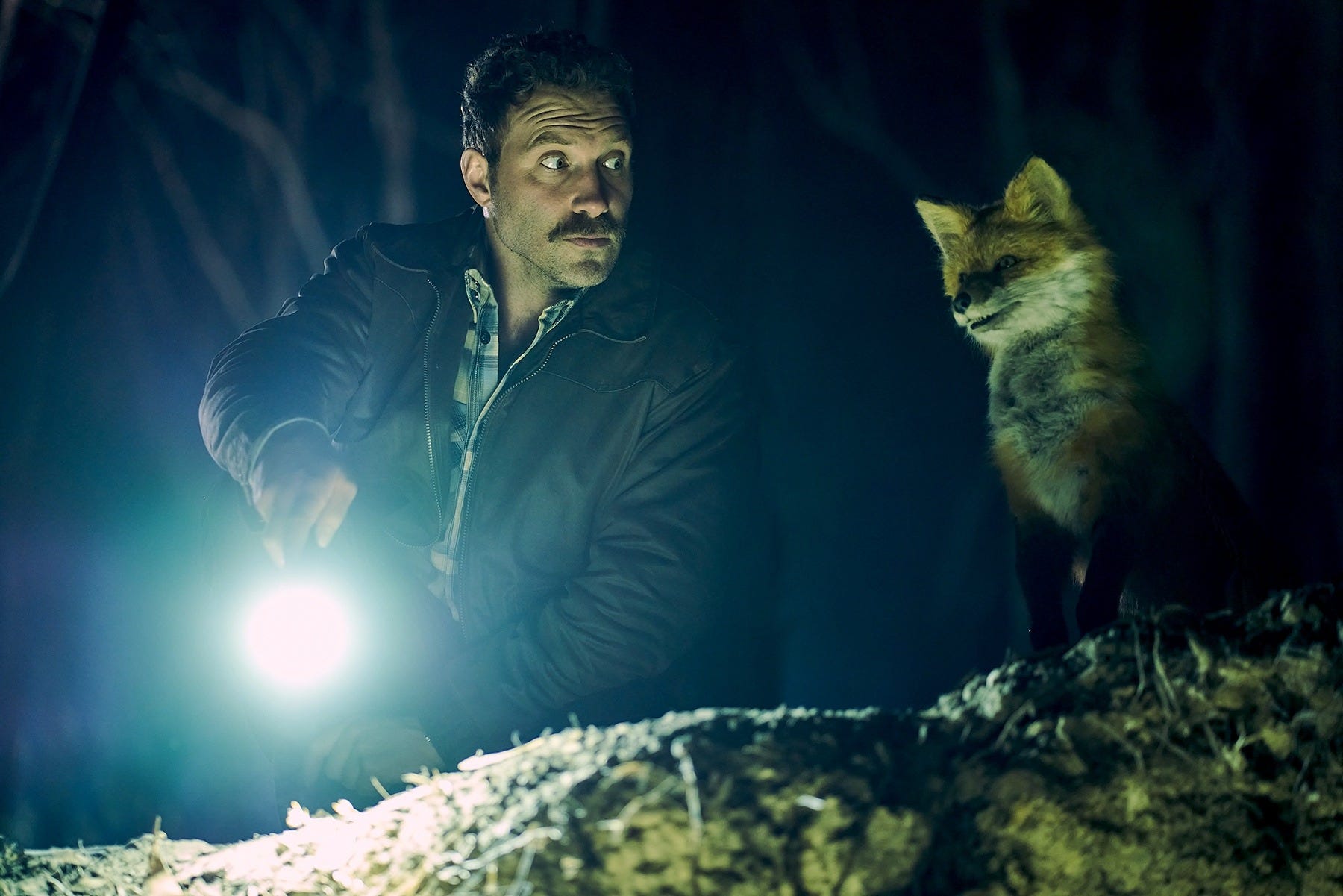
It’s not a surprise that Kori is having an affair with her boss Derek (Damon Herriman), who himself is married to Diana (Claudia Doumit), Kori’s best friend. After Nick finds out about his fiancée’s scandal, he meets a talking fox (Olivia Coleman) he’s hunting, who offers to fix Kori in exchange for his life. He accepts and concocts a plan with Diana to get Kori down a hole in the forest from which she should return as a loving, attentive, and lustful partner for Nick.
Russo’s mastery comes from perfectly handling all the tonal shifts and keeping the film’s zany style. Stylistically, it’s an effective mishmash of Wes Anderson with a type of Australiana I call “posh bogan”, which mostly comes from someone whose idea of remote and rural Australia is a reflection of their own suburban lifestyle - nothing wrong with that; it’s a choice. But when the talking Fox (and cussing Magpie, voiced by Sam Neil in one of his last roles), the film becomes a moral fantasy similar to The Stepford Wives.
It’s not a bad idea, but Russo misses the chance to turn the story into strong satire. Without spoiling, the magic that “fixes” Kai is found to be connected to the town’s troubled past. It samples Australia’s gender disparity, but without touching on the social aspect of it. It’s also undermined by some beats that, while making sense in the development of the plot, do nothing to expand the idea. Exactly the opposite of what Boots Riley did with I Love Boosters earlier this month.
It remains funny, though. The late Neil is fantastic as the abrasive magpie, and Coleman (on her second Australian feature of the year) has the right kind of devious whimsy in her voice. Courtney nails a role for the second time in his career, after excelling in last year’s Dangerous Animals, making us think that he was born to portray stereotypically toxic Australian men. Browning is the standout star, especially as she plays her character in five different dimensions - the unhappy wife, the lustful lover, the brainwashed wife, and two more that revealing here would be a disservice to the film’s surprising twist.
The Fox shows Russo can hold a feature with ease, but if his earlier work says something, it’s that he has braver ideas in him. While the concept is outlandish, Russo works it according to our expectations, with a seriousness he doesn’t fully grasp. Throughout the film, the characters repeat the mantra “it is what it is” as a simple example of Australianism, part of this country’s output in life. Coming from an outsider, I think there’s an even stronger aspect of the Australian way of thinking, the “that’ll do” - the idea that if the idea is strong, it doesn’t have to be perfected if it delivers what it promises. It’s what gave this country fairy bread and putting sausages on a square of white bread instead of a long hot dog bun. If it does the trick, why overcomplicate it? The Fox is what it is, and that’ll do.
The plus: A fun idea sprinkled with enough cultural details to make an impact in this country …
The minus: … but its concept lacks a philosophical stamp that could have elevated it.