
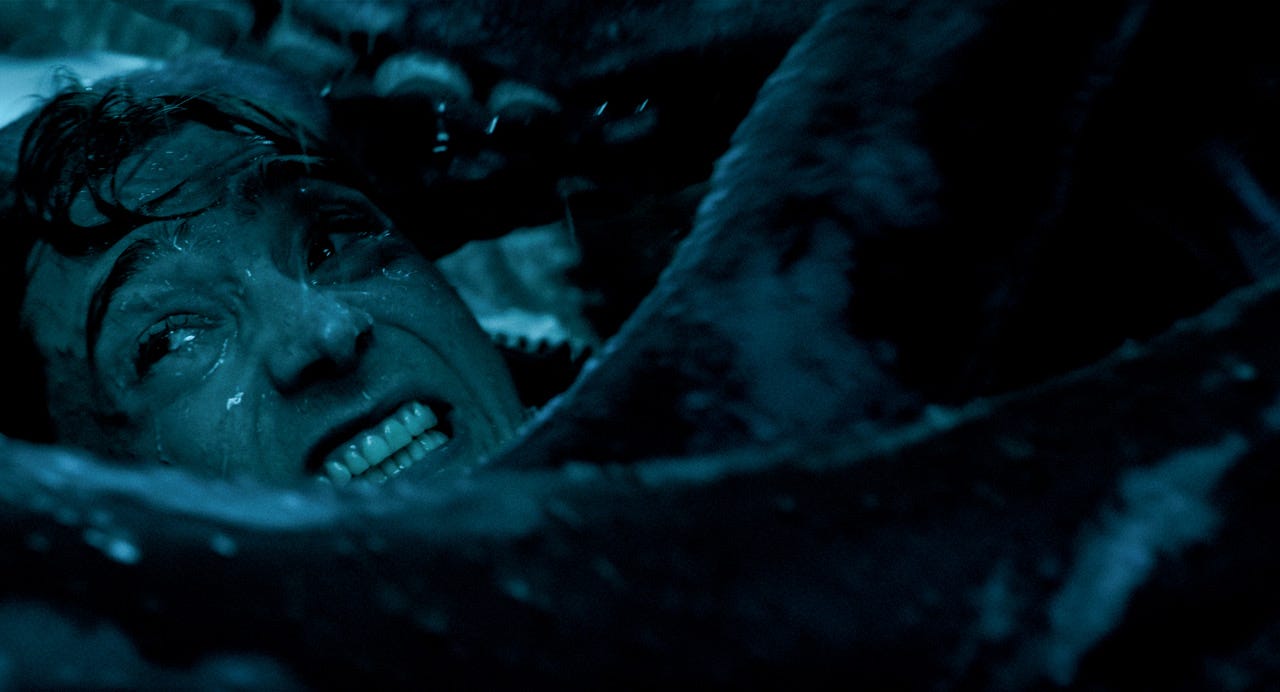
Brian Duffield’s claustrophobic thriller starts and ends with the very simple proposition of how a man can survive inside a sperm whale. Everything else surrounding it could’ve been inconsequential, but Duffield has the intelligence to give its outlandish setup a raison d’être.
Jay (Austin Abrams) is not having a good time. His father (Josh Brolin) died of suicide by delivering himself to the will of the ocean before the cancer took hold of him. He came back to town for the funeral procedures, which evidently means finding inner closure. You see, Jay’s father was a rough-around-the-edges man of the sea, who wanted to imbue his son with his philosophy of respecting the ocean and resisting the philosophy of tourism that exhausts natural resources to feed the never-ending appetite of the capitalist machine. But Jay, being a teenager, reacts as disinterested teenagers ought to be. Now that he’s gone, he regrets his way and demands closure, which he decides comes by finding his father’s body in the bottom of the ocean.
So off Jay goes, equipped to the tee and holding the knowledge his father told him through the years, or at least what he paid attention to. Off he goes, appreciating the immense void in front of him, in a rare moment of calm before the nightmare. And then it happens. A sperm whale chases a giant squid, and in the middle of the fight sucks poor Jay, squid and all, into its stomach.
And that’s the story, the premise and the concept behind Whalefall. A man inside a whale eventually faces his demons until he can reconcile with them in a way that represents both his physical and emotional liberation. Duffield doesn’t explain much about the anatomy of an animal. He’s in a “chamber” (if we can call it that), the moth is that way, the stomach, filled with skin-eating acid, is that way. He finds ingenious tools that help him in his endeavour, including the beak of a squid as a makeshift pickaxe, and glowing jellyfish for light. Duffield doesn’t risk losing the audience’s interest by finding a good balance between the emotional narrative of the father-and-son story and the outlandish but objectively entertaining story of the man inside a whale.
It works because Duffield knows how to create an intense, claustrophobic environment. His previous directorial effort was the surprisingly good No One Will Save You, where a traumatised, anxious young woman tries to survive the night while an alien is invading her house. Before that, he wrote Underwater, a film that is undeservedly forgotten, in which Kristen Stewart is alone in a destroyed underwater research facility. Whalefall is the perfect conflation between the two.
Abrams, who, with this and Resident Evil, is having a great statement year and a calling card for casting agents paying attention, delivers the kind of effective performance that Hollywood appreciates. He doesn’t chew the scenery nor take protagonism from the story’s spirit. There’s something simple about his performance that reminded me of Michael J. Fox: an all-American wholesomeness that is grounded in relatability.
It’s no surprise Whalefall works so well. It’s validated by the pedigree behind it. But even then, it came as a surprise. After a lengthy introduction (which caught off-guard even the most patient filmgoer who was promised man-in-whale), the swallowing scene managed to grab the attention of the entire cinema. Expertly edited, with a pointed sense of pacing, it ends in a cathartic moment before it cuts to black. For a couple of seconds, Duffield lets the audience reason with what just happened and in the nervousness of it all, everyone starts to chuckle out of respect. Maybe the rest of the film doesn’t live up to the grandeur of that scene, but Duffield gives his best trying.
Maybe there’s not much more to it. At this point, I hope to see him grow as a filmmaker into something that strives to be more than just a good, well-paced thriller. Even the father-son story, like the trauma in No One Will Save You, is reduced to very simplistic beats that risk being distinctive for their universality. But for now, that’s not important. What he sets out to do, he delivers as promised.
The plus: Effective and emotional filmmaking, supported by a very experienced central performance
The minus: The third act is a bit of a stretch of suspension of disbelief that adds a strange spirituality to a story that does not warrant it.