
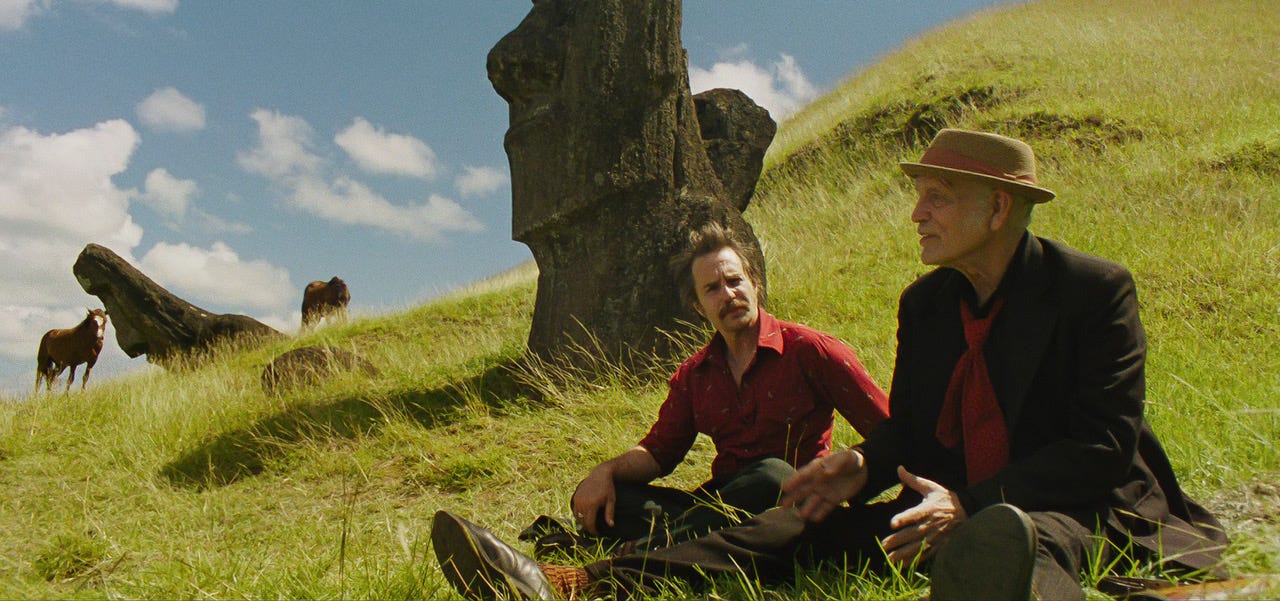
The world of Martin McDonagh is populated by old men facing their mortality, swimming in a sea of regret. And next to them is often a younger version of themselves, full of sprite and ideological oomph, that holds the key to the old men’s peace. So it was in In Bruges and in The Banshees of Inisherin. So it is in his new film, Wild Horse Nine.
The old man is Chris (John Malkovich), an aging CIA agent assigned to Chile one year into the presidency of the (democratically elected) Marxist leader, Salvador Allende. The young man is his colleague Lee (Sam Rockwell), who is assigned to accompany Chris on a trip to see the “big heads” on Easter Island. Their boss, MJ (Steve Buscemi) stays in Santiago and regularly checks with Lee about the situation. This is not a simple holiday trip. As the agency is preparing the coup that will depose Allende, start the ruthless dictatorship of Augusto Pinochet, and signal the brutal murder of thousands of people, Chris is near the end of his cancer journey and slowly losing his grasp on reality.
The shadow of antidemocratic oppression floats through most of the film. On the way to the island, Chris jokes with two young Chilean students (Mariana di Girolamo and Ailín Salas) that he is in Chile to destabilise their democracy. It’s all true. He is there for that purpose. Every shot of MJ in Santiago is in the presence of high-ranking military personnel - the same people who will take over the country when Allende is removed. Chris’ career is brought up several times, first as a badge of honour, and later as a grim realisation of America’s postcolonial plan. This is part of the reason why he wants to write a memoir by rambling on a dictaphone. The CIA isn’t that interested in what he may reveal - in the end, they are also proud of the democracies they helped destroy. But MJ orders Lee to find out the details of one specific past mission. In 1963, Chris may or may not have been part of a CIA plot to assassinate JFK.
In spite of all the big plot ideas, Wild Horse Nine plays with the quiet candour of a theatre play (understandable, as McDonagh started, very successfully, as a playwright). In almost every scene, Chris and Lee, like Vladimir and Estragon, exchange ideas while they wait for the inevitable. Sometimes it’s funny, like when Chris goes on a rant about how the gayer the country is, the better the cheese they produce. But it’s always enveloped in this sad cloak of a life dedicated to creating sadness and misery wherever it goes. Without realising it, Chris is responsible for the subsequent decades of war and oppression in the world. He is an angel of death, accepting his regret, not seeking redemption.
But it’s curious that McDonagh struggles to write American characters. I noticed the same in Three Billboards Outside Ebbing, Missouri and Seven Psychopaths. His dialogue is sharp and sardonic. Too sharp and too sardonic for an American to convincingly say it. Even the emotional toll of regret and isolation is inherently Irish or, at least, Northern European. It’s way too earnest for the land of braggadociousness. Philosophically, the best moments for McDonagh are when he gets his protagonists interacting with someone from back home. Lee talks to his wife Margie (Parker Posey), a hateful drunk and entitled socialite who openly cheats on her husband; and Chris talks to his estranged brother Jim (Tom Waits), who lives alone in the middle of Monument Valley and whose relationship was destroyed because of JFK (curiously, not because of all the other democracies Chris helped destroy).
More than McDonagh’s, this is Malkovich’s film. His fragility is only comparable to his charm. In a great moment, he connects with one of the Chilean students (Di Girolamo, who excelled in Pablo Larraín’s Ema) and takes her on a date to a bar to listen to none other than Víctor Jara (“he’s on our list”, he tells her). If McDonagh’s style doesn’t fit Americans, his solemn tone with a dash of comedy fits Malkovich perfectly, who sells Chris’ monologues with precise detail. He nails the final monologue, so perfectly it rounds up the entire film. In doing so, he extracts the emotional core of that story that, without him, probably wouldn’t have worked.
The plus: Malkovich getting his overdue recognition. Only an actor with theatre and film experience could’ve done what he does here.
The minus: A liberal Chilean student would not arrive late to a Víctor Jara gig, spend the entire time talking, and then leave before the end. McDonagh wouldn’t do that to Shane MacGowa