
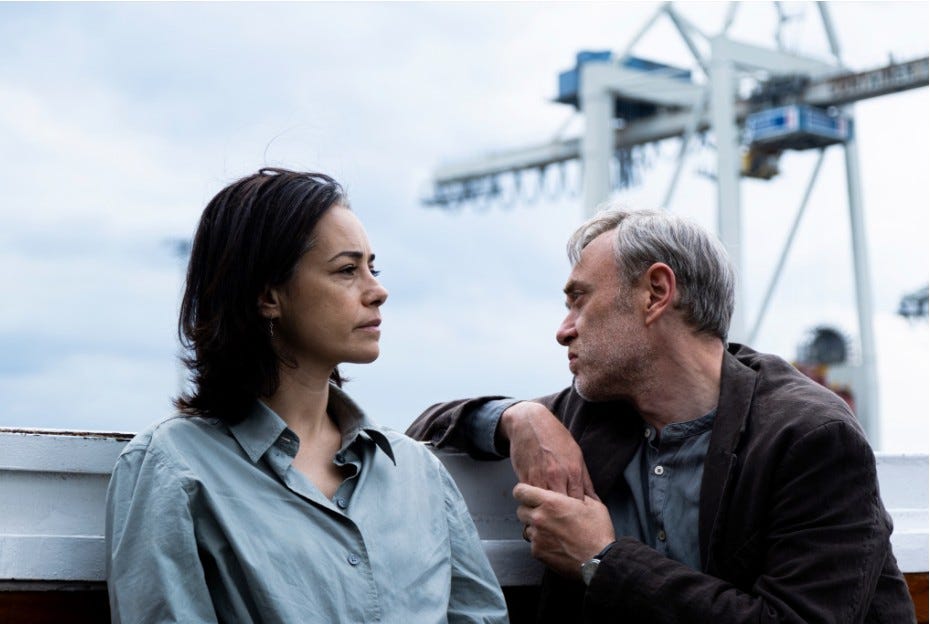
The simple and effective political power of cinema sits in the front seat of German-Turkish filmmaker Ilker Çatak’s new film, Yellow Letters, a film whose mere existence is an act of defiance. Yet behind the revolutionary ideas and terrific performances is a modest, and maybe generic, formality.
Earlier this year, at the Berlin Film Festival, the then president of the jury Wim Wenders, said something so profoundly ignorant, it may be the only time in history any of us could feel more intelligent than the man who made Paris, Texas and Wings of Desire. “We have to stay out of politics”, he said, “because if we make movies that are dedicatedly political, we enter the field of politics.” The statement, ironically, was political. Two years earlier, a group of artists accused Israel of genocide during the closing ceremony of the festival, prompting a backlash from the German local and federal governments, which have a history of shutting down pro-Palestinian voices. Because of the incident, some politicians called for the funding of the festivals to be pulled, while the Minister of Culture announced an investigation into what happened. So, in an effort to please the government that secures its funding, and as the political situation in the Middle East has only gotten increasingly worse, Wenders dropped the most ignorant thing an artist, of any kind, could say.
Every - and I mean every- art is political. Even the absence of an ideology is a political stance. Every action we take, every one of our messages, has a political edge. And that is something to be celebrated.
So it’s hilarious that Wenders would give the Golden Bear to Yellow Letters, a film where politics is not just central to the story. It’s a part of its concept.
Right at the start, the film declares “Berlin as Ankara”, explaining that the German capital will double as the Turkish capital and that Çatak won’t hide that. Even that is an act of defiance, which can have several meanings. Is this the film (in Turkish, with just Turkish actors) exhaling itself from Turkey? Or is Çatak comparing the authoritarian Turkiye with the democratic Germany? The answer is both.
Derya (Özgü Namal) is a renowned theatre actress married to a dramaturgist and university lecturer, Aziz (Tansu Biçer). The couple enjoy a life of free liberalism, where notions are challenged and ideas are exchanged. Aziz is dismissed by the university, along with several of his colleagues, in theory because of accusations from other students that they neglected their lessons, but it’s blatantly because of their political ideas. Tension rises in the country, people are accused of being terrorist sympathisers, bullied and pressured by the authorities. When Derya receives her own dismissal (in the form of a yellow letter issued to announce the end of their employment) from the theatre company, the couple moves to Istanbul (or Hamburg in this case) to Aziz’s mother’s house, and close to Derya’s very religious brother, putting a strain on the couple’s marriage.
The easy read sees Yellow Letters as a takedown of Erdoğan’s government, but Çatak takes it a notch further. There are LGBT flags next to Palestinian flags in the students’ protest, reminding us that all these fights for freedom of speech are intersectional; but also because Germany has attacked and repressed many forms of expression of support for the Palestinian people.
Çatak is clever never to explain why the country is silencing liberal voices. Seeing this pressure and prosecution on a European background is a jarring realisation that should serve as a warning of the route Germany is taking. It’s not a violent takeover; it’s coercion through societal pressure.
Later in the film, Derya and Aziz work together on a new play, and when Derya proposes that her character be undressed (the play is a blatant metaphor about airport security guards forcing a woman to undress until the metal detector stops beeping). She claims it makes sense for the scene (she is correct), but knowing what a naked woman on stage would attract leads Aziz and his producers to self-censor. The final stage of authoritarianism is reached when the artist takes a step back from his self-expression.
If this is the film Wenders awarded, then his comments at the start of the festival were muted and made to please the establishment. One can argue that’s an immoral position, if he didn’t really mean it. But maybe Wenders knew what he was doing. Art that isn’t political is toothless and unimportant. Knowing her vision is compromised, Derya turns to low-brow acting and joins the cast of a successful soap opera. Because if it’s to have no spine, have no spine in style.
The plus: A brave concept that directly analyses the effects of authoritarianism in modern society.
The minus: It is unfortunately mundane: not enough to tamper with the enjoyment (visually there’s nothing wrong with it), but just enough to not make it a masterpiece.