
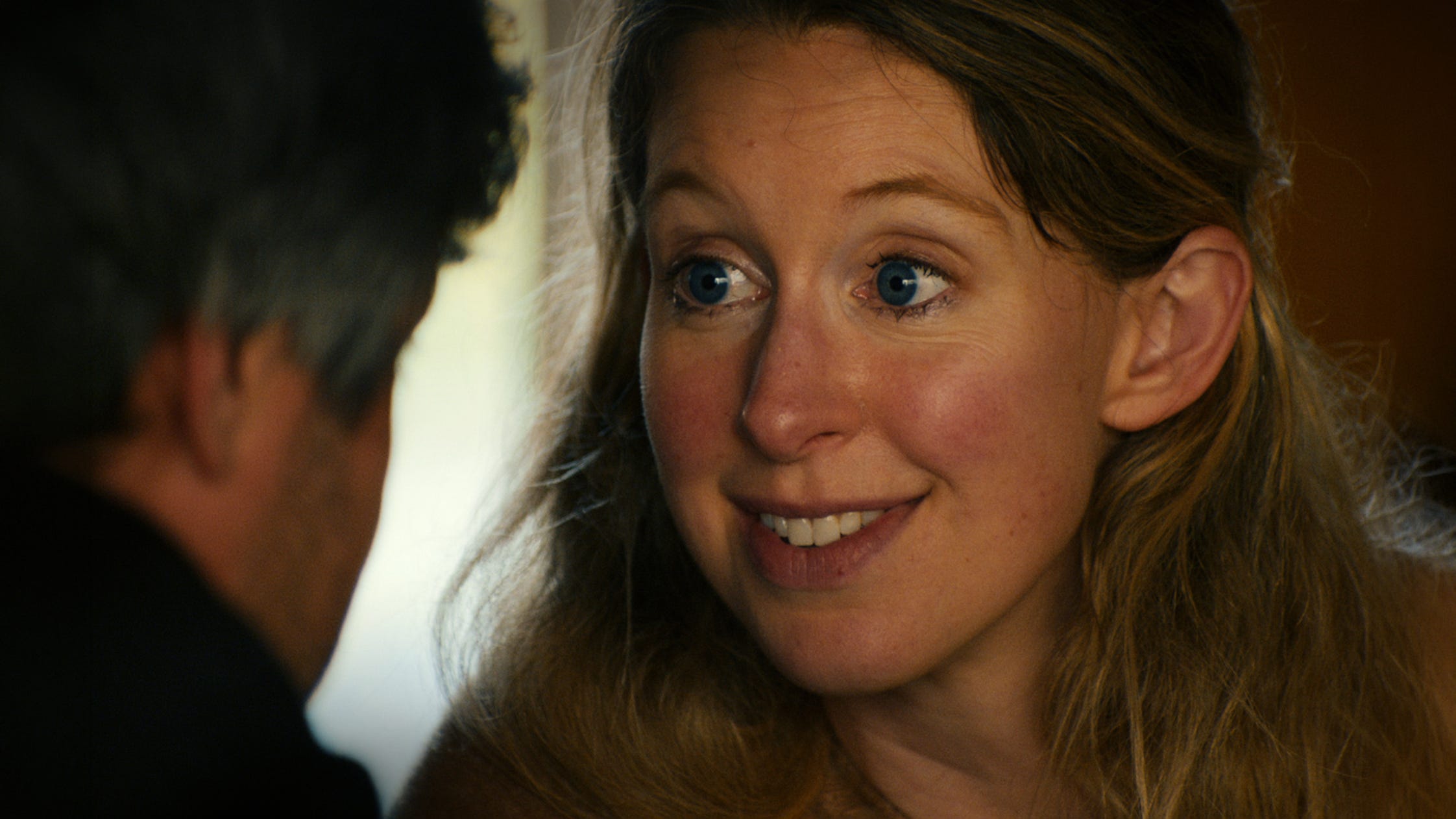
Lance Oppenheim and Nathan Fielder’s documentary following Elizabeth Holmes’s last month of freedom before she has to serve an 11-year sentence for fraud (and her life two years into that sentence) is not the best way to understand who Holmes is. Or maybe it is? Fielder has never been one to answer any questions; his style hinges more on the audacity of his actions and how the rest of the world reacts to it. But here, the audacity is on Holmes and her husband Billy, who not only invite Fielder to their home 24/7; it was their idea to begin with. Through these almost three hours, You Can See Everything poses plenty of questions and barely answers any of them.
If you’ve been blessed by an existence away from internet culture, Elizabeth Holmes is the personification of all that is wrong in America in the digital age. A self-made millionaire who rose to the top of Forbes’ list of most influential women and youngest millionaire by inventing a machine that could analyse a person’s blood and deliver a flawless diagnosis in a couple of minutes from just a drop of blood. Her company, Theranos (a blend of ‘therapy’ and ‘diagnosis’), raised almost $900 million in capital before it was discovered that the technology did not work and Holmes had in fact tricked investors for years. Her story was the subject of documentaries, news investigations, books, podcasts and miniseries with Amanda Seyfried as Elizabeth Holmes, and in all she is portrayed as a savvy, manipulative business leader. A mindset on the philosophy that if you believe in a lie hard enough, it eventually comes true.
If you’ve missed the derangement of Nathan Fielder, you really should take your time with it. He started with a quirky comedy documentary called Nathan For You, where he would help struggling businesses by giving them the most counterproductive, unhelpful recommendations (like telling a yogurt shop selling a poop flavour, or changing the name of a coffee shop to “Dumb Starbucks). Then there’s The Rehearsal, the HBO docuseries where Fielder helps ordinary people prepare for big events in their lives by building hyper-realistic sets for them to play their scenarios.
The allure of You Can See Everything is right there in the premise of these two master manipulators facing each other. Fielder’s schtick is that no one, not even his fans, knows when he’s real or playing a character. When the first teaser for this was released, setting the whole internet on fire, it felt like the whole thing was a plot.
Fielder’s magic trick was that we were not the spectators but the illusion. A couple of weeks ago, Wire magazine posted an interview with him that didn’t manage to unveil anything about this. “Had the publicist looked me in the eyes and lied? Had Nathan?” writes the journalist Katie Drummond. “I considered asking them outright. I’ve never been one for ambiguity, and a journalist craves nothing more than to know what’s real. Then again, people make things up all the time. They present different versions of themselves to different people, obfuscate and perform, and they do it in little ways and sometimes bigger ones. Did it really matter if he’d left for a real meeting or the excuse of one? And hadn’t I spent enough time letting Nathan Fielder make me feel crazy?”
You Can See Everything is the type of film I like to write about, because it forces me to step away from what happens in it, and instead think about the repercussions of what I just saw. To the credit of those who’ve seen it (the film has been released in the United States already), the big twists and reveals have been kept away from social media to preserve the purity of the experience for the rest of us. You Can See Everything is a puzzle that unfolds slowly in front of us. It’s confusing but calculating, in a way that you’re never quite sure of what everyone’s intentions are, even after multiple viewings. In the first half, Oppenheim films everything between wide angles and face close-ups, almost like a horror movie (Fielder often shot lurking in the background as if he’s Michael Myers in Halloween). But in the second half, he switches the tone to an Alan J. Pakula paranoid thriller, with convoluted plans and secret revelations.
Do you know the Buddhist parable of the blind men who each are told to touch a different part of an elephant? They can perfectly describe the part they touched, but not the animal as a whole. You Can See Everything is as if a blind man was told to touch an entire animal, perfectly described an elephant, but it was a giraffe the whole time. The lesson of its title is that “seeing” doesn’t mean “understanding”, and the frustration of the film (a good frustration, I might say) is that “understanding” is a privilege humans don’t have. We take the word for granted, but so easily, and for a good reason, we don’t trust the person on the other side.
Holmes’ partner, Billy, ends up being the most genuine and transparent person in this bizarrely plotted web. But here it’s not a compliment. Billy is the worst kind of man. The ultra-aware of his manliness man. The Trump-voting, anti-woke, Musk-loving kind of man. His intentions are clear from the start, and not a surprise when they develop into something larger and a more toxic monster.
I don’t know what You Can See Everything has to say about us, but in an almost philosophical sense, it’s the audience that ends up being the rabbit in the hat. I wish I could discuss it for longer, analyse the every look and eye twitch. But I also know that all I see is controlled by Fielder and Oppenheim, who curate this insane piece of art with the purpose of accusing modern society of replacing human empathy with our eagerness to be entertained by pointless sleuthing.
The plus: A paranoid experience so cleverly crafted I’m not 100 per cent sure we’re not living its sequel. All ethical questions are valid but also part of the film’s point.
The minus: If Fielder is to top this one day, he may have to kill someone.