
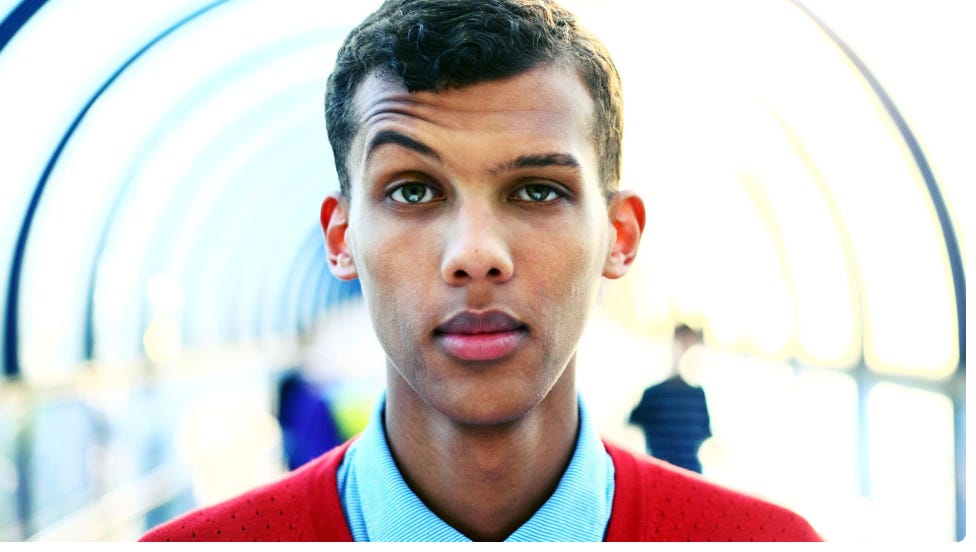
In June, international sensation Tove Lo (”Too-ve-loo”) paired up with a dance music icon for the single “des fleurs”. That icon, Stromae, boasts more than a decade’s worth of albums, remixes, and live performances that the curious ear ought to seek out.
And musical curiosity is a must if you’re going to love Stromae, because the Belgian artist has variously called on his skills in singing, rap and production to craft smooth productions from hip hop to French touch, disco, funk and RnB. If I were to throw a Stromae record (of the vinyl variety) into a crate of like-minded acts, I’d pick his neighbours to be an international hotchpotch: Daft Punk, Justice, Simian Mobile Disco, LCD Soundsystem, Klaxons and Yeasayer. I guess, if you must, the 2026 version would be a playlist highlighting the best of all of these electro-punk clubkids of the mid-2000s.
My entry into the Stromae universe came with the release of hit single “Alors on danse“ in 2009. The repeated electro-synth pulse driving the track is deceptively simple: but layered up with spoken-word style verse-and-chorus in French, and the clever use of MIDI instruments, it becomes catnip for the club. That track led me to his debut 2010 album, “Cheese”, which propelled Stromae to number one in a handful of European countries. The vocals are entirely in French, defying the description of “rap” with a much more laid-back, almost disinterested delivery. There’s a charm to the singer’s indifference, not unlike the off-tune, sometimes ridiculous vocals in French electro masters Justice or the dance-punkers The Rapture.
For the many listeners who don’t speak fluent French, the thoroughly addictive synthpop melodies do the heavy lifting.
Though less evident on “Cheese”, later albums to date have seen Stromae (born Paul Van Haver) extend his delivery into balladry, sometimes channelling a heartbroken Edith Piaf, or a defiant Marlene Dietrich. While that might seem absurd for a young Dutchman born to a Somali-Rwandan father and Flemish mother, it sounds thoroughly romantic, melancholy and sincere in delivery. Perhaps it is his earliest influences. The artist has spoken of his love for Jacques Brel, a passion his mother stoked through his childhood.
Reviewers have persistently referred to Stromae as a rapper: isn’t wrong but it also doesn’t account for the many strings to his bow. Though his teenage years and early twenties were packed with performances in a rap duo, then solo, “Alors on danse” defies the genre pigeonhole. Indeed, hitmakers from the U.S. pop, hip-hop and dance worlds came calling on the heels of “Alors on danse”, including Kanye and the Black Eyed Peas. Years later, Lorde, Diplo and Coldplay all came with invitations to collaborate.
With the Tove Lo collab, “des fleures”, Stromae has again snuck into the pop world with his French synthpop stylings, without demanding the spotlight. But, arguably, newer synthpop artists Angèle and Aya Nakamura, who also unashamedly perform in full French, walk a path smoothed by Stromae, as well as the retro Euro-disco beats peddled by Dua Lipa and Harry Styles, that ghostly melodic legacy back to French Touch and Belgian pop lingers.
Most likely to pop up on compilation and soundtrack albums in recent years, I cannot recommend enough that those with a bent for hooky, Euro house-pop with (more than) a shade of retro kitschiness, to go exploring deep into the Stromae YouTube. You might find “Ma Meilleure Ennemie”, his slow trap, ethereal ballad with Coldplay’s crooning Chris Martin over a super-smooth two-step beat. You might discover cumbia-flavoured “Santé ”, or the melodramatic, celebratory beat of “ta fête” from the 2022 album “Multitude” (including the live version on The Tonight Show with Jimmy Fallon), or - a personal highlight - the Tiny Desk Concert for NPR in 2023. You might discover first, as I did, a very young Stromae escaping his office job with one singular, endless mantra: “Alors on danse!” (”So, let’s dance!”)
