
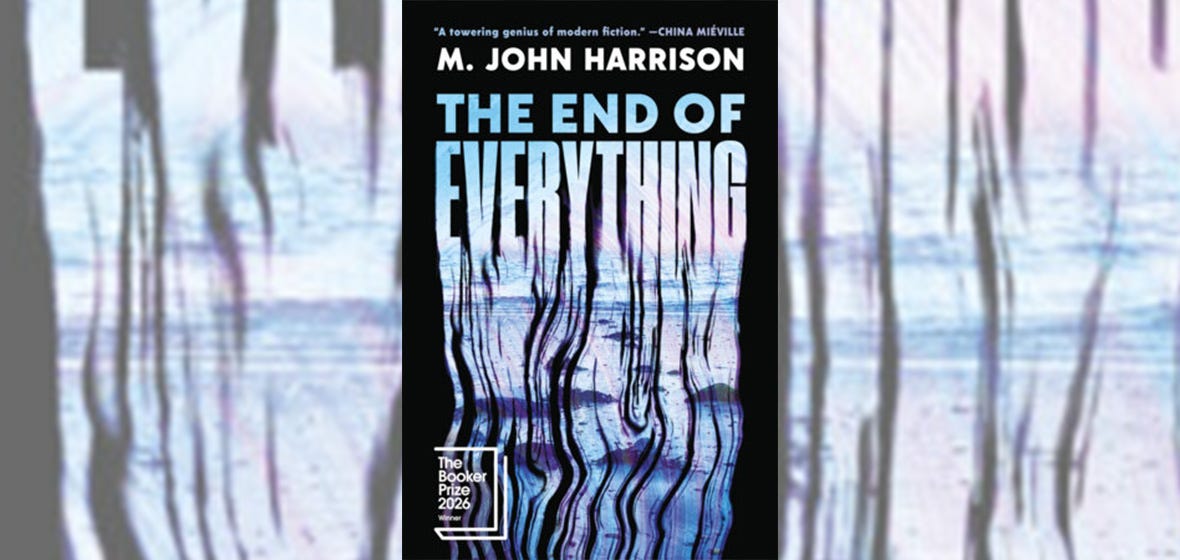
Historian Mary Beard, the chair of this year’s Booker Prize, says the decision to crown The End of Everything as this year’s winner was a unanimous decision, reached after a full day of deliberation. The result was surprising to many in literary circles: Marlon James, a former winner, was the favourite for his sprawling The Disappearers, the 600-plus-page novel that The New York Times recently declared “the novel of the decade, if not the century.” Scottish novelist Douglas Stuart was also considered a likely winner for John of John, an intimate and devastating queer love story. So, how did a science fiction story, coming in at a slim 200 pages, become what the Prize’s Chief Executive Gaby Wood described as “the first Booker winner to have emerged from the bona fide SF [science fiction] world”? And in doing so, make M John Harrison, at age 81, the oldest winner in Booker history?
The Occam’s Razor and first reason is The End of Everything is simply a fantastic book. At times, it reads like a thriller with quick beats and a propulsive pace. Given Harrison’s career of 60 years writing mostly in the science fiction and fantasy genres, it’s not surprising that it easily succeeds in world-building and postapocalyptic unease. But perhaps its greatest accomplishment is achieving this, when the central idea of The End of Everything is that we know so little about this world: how the disaster has come to be, what in some ways the disaster even is. In a week where a three-hour documentary is bending everyone’s minds as to what subjective truth is, and questioning whether it is possible to even be obtained, this book feels even more like the winner we need and deserve right now (this is not a glowing endorsement of us).
The two central characters of The End of Everything are beachcomber Phillip Tennent and his elderly aunt Marine. Phillip is a collector of artefacts, washed-up debris along the Kentish coast. It is clear early on that the artefacts have some life form; their flesh is “translucent as sandwich ham”, their arms “primitive.” The artefacts have been released by the iGhetti, the unusual and obscure trigger of the crisis that shut down the world (Judge Beard herself speculated as to whether the lowercase ‘i’ is a deliberate nod to the Apple products that have attached themselves permanently to our hands). No one knows what is happening now, and no one understands how they even got to this point; the crisis kicked off “a decade of confusion” with declining populations and economic crises across Europe. Technology, the century’s greatest convenience, was not there to save us; “social media was as useless as ever, and though the war with the iGhetti continued, people could never agree on what kind of war it was, or what the boundaries were.” There are fleeting mentions of Thatcher and Covid, but we don’t know how far from that time we are right now.
Often in postapocalyptic stories, one of the first ideas to disappear is the innocence of childhood, and the grace afforded to the young. In The End of Everything, when Phillip meanders in a story to Marnie about not knowing the difference between flotsam and jetsam, she rebukes him “You’re not a teenager anymore”. Yet in an early scene, when an act of vengeance is inflicted on a boy for a revolting prank, the crowd turns on the character seeking revenge; “he was only twelve”, they repeat. It was one of the few markers of a pre-existing social order I could find in its pages, as almost every other act in this book is absent of any consideration or rationality. The bleakness of a depleted and desperate England also has echoes of another brilliant science fiction novel, The Death of Grass.
Last year, the New York Times published its best books of the 21st century, and amid the criticism and takes that followed such a list was an observation that the 100 selected titles largely existed in the vague realm of literary fiction. Crime and science fiction and other genre delights were missing. A month before his win, M John Harrison told BBC Radio 4 he had spent his writing life working to adjust this thinking. “Why shouldn’t a well-written [science fiction] be considered literary fiction?” he posited. Maybe, for genre titles seeking their flowers, this is just the beginning.